
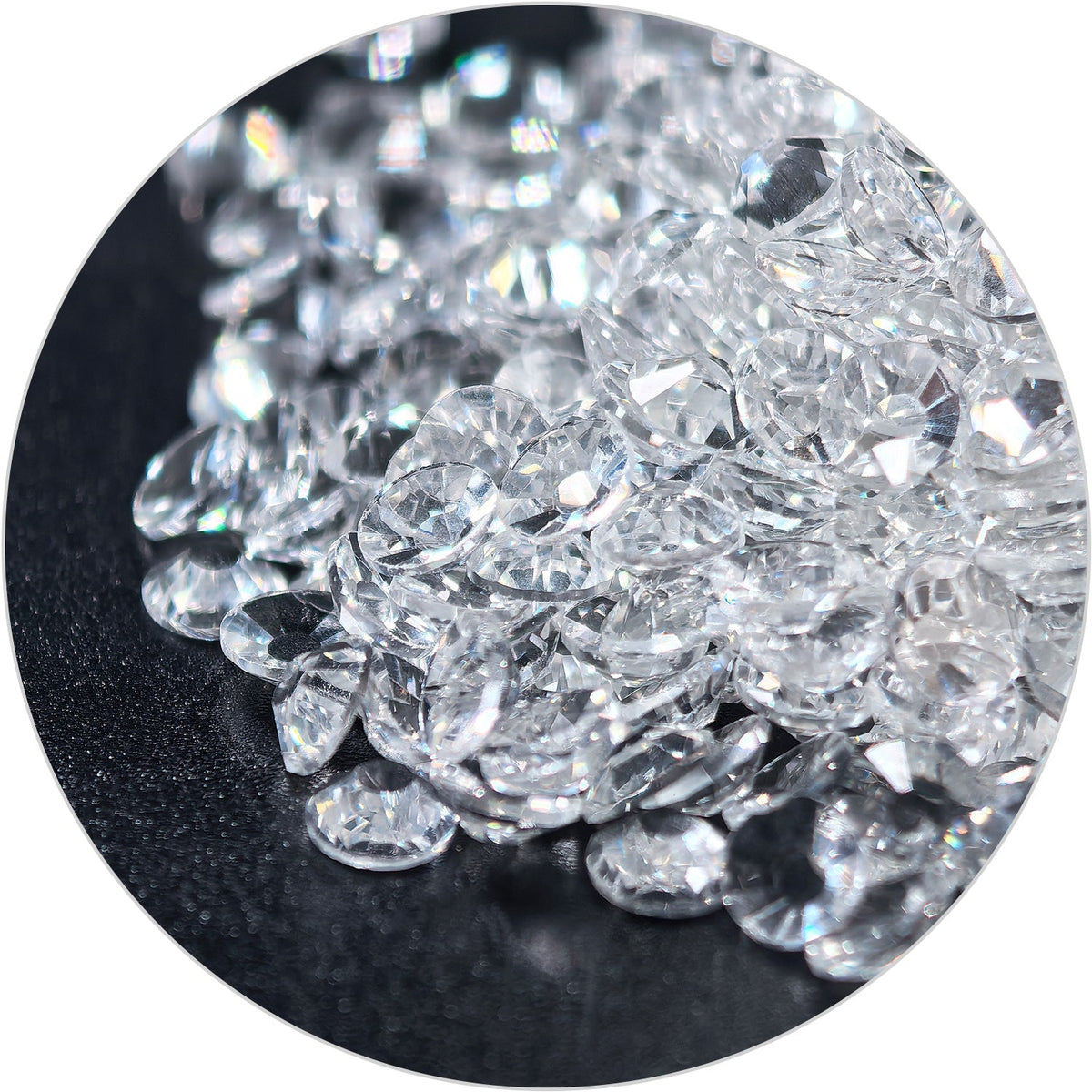
Quick Answer: Rhinestone terminology only looks intimidating. Here is what you actually need to know. SS (Stone Size) is the standard sizing system — SS10 = 2.3 mm, SS20 = 3.3 mm, SS30 = 4.0 mm. AB (Aurora Borealis) is an iridescent rainbow coating, not a color or shape. A gross equals 144 stones — the universal wholesale unit. Hotfix stones use heat-activated adhesive; flatbacks require glue. The standard chaton cut has 8 crown facets plus 8 pavilion facets with a foil backing for maximum sparkle. This guide defines all 50+ terms you will encounter when buying rhinestones wholesale, organized by the decisions you actually make.
You are three supplier tabs deep at 10 PM, and every product page throws another abbreviation at you. SS12. AB. Chaton. Hotfix. Gross. Foil-backed. Pointed back. The search filters alone feel like a foreign language exam you never signed up for. You know what a rhinestone looks like — but do you know which one to actually order?
This confusion is the single most common reason buyers overpay, order the wrong stones, or end up with boxes of rhinestones they cannot use. The rhinestone industry has its own vocabulary, developed over more than a century since the first crystal chatons were produced in the Rhine Valley. And almost nobody takes the time to explain it properly — until now.
Welcome to the rhinestone glossary we wished existed when we started sourcing. Every term you will encounter is here, organized not alphabetically but by the real decisions you face: sizing, materials, application methods, finishes, shapes, and brands. Read it once, and you will never confuse a hotfix with a flatback again.
Part 1: Understanding Rhinestone Sizing — Why SS Numbers Matter
If you learn only one system, learn this one. The SS (Stone Size) numbering system is the universal language of rhinestone dimensions. Developed by Swarovski and adopted industry-wide, it lets buyers anywhere in the world specify exact sizes without ambiguity. Without it, you are guessing by eye — and guessing costs money.
Why SS sizing matters: Ordering the wrong SS size is the most common purchasing mistake. SS10 (2.3 mm) looks noticeably smaller than SS16 (3.0 mm) when placed side by side on fabric. A stage costume viewed from 20 feet needs SS30 or larger. A delicate blouse worn at arm's length needs SS12 to SS16. Choosing the wrong size means wasted money, missed deadlines, and a redesign.
SS to Millimeter Conversion Chart
Bookmark this table. Every supplier uses SS numbers, and many list them without millimeter equivalents.
| SS Number | Diameter (mm) |
|---|---|
| SS3 | 1.3 mm |
| SS5 | 1.5 mm |
| SS6 | 1.7 mm |
| SS7 | 1.9 mm |
| SS8 | 2.0 mm |
| SS9 | 2.2 mm |
| SS10 | 2.3 mm |
| SS12 | 2.6 mm |
| SS16 | 3.0 mm |
| SS20 | 3.3 mm |
| SS30 | 4.0 mm |
| SS34 | 4.5 mm |
| SS40 | 5.0 mm |
| SS48 | 6.0 mm |
Pro tip: When in doubt, buy a sample stone or a small vial before committing to a bulk order. Visualizing 2.3 mm versus 3.0 mm on a screen is impossible — holding them in your hand takes one second.
How to Choose the Right SS Size
Your project's viewing distance and fabric weight determine the correct size:
- Close-range apparel (everyday wear, seen from 1 to 3 feet): SS10 to SS16 (2.3 to 3.0 mm). These sizes read as elegant sparkle without looking gaudy.
- Stage and performance costumes (seen from 10 to 30+ feet): SS30 to SS48 (4.0 to 6.0 mm). Larger stones catch stage lighting and read clearly from a distance.
- Bridal and evening wear: SS12 to SS20 (2.6 to 3.3 mm). A mix of sizes creates dimension — smaller stones for fill, larger stones for focal points.
- Nail art and crafts: SS3 to SS10 (1.3 to 2.3 mm). Small stones work best on curved, small-area surfaces.
Gross Quantities — The Wholesale Unit You Must Understand
Rhinestones are almost never priced per stone at wholesale level. Instead, suppliers quote prices per gross:
- 1 gross = 144 stones (12 dozen) — the standard wholesale unit
- 1 half-gross = 72 stones
- 1 quarter-gross = 36 stones
Why gross pricing matters: When you see "SS12 rhinestones, $8 per gross," that is $8 for 144 stones — roughly 5.6 cents per stone. If you do the math, you will immediately spot overpriced listings. Some sellers quote per stone to hide high margins. Always convert to per-gross pricing before comparing suppliers.
Part 2: Rhinestone Materials Compared — Crystal vs. Glass vs. Acrylic
Not all rhinestones are created equal. The material determines sparkle, weight, durability, and price. Choosing the wrong material is the second most common buying mistake.
Material Comparison Table
| Property | Crystal | Glass | Acrylic |
|---|---|---|---|
| Sparkle | Highest — refractive index up to 2.0+ | Medium — good clarity, lower RI | Low — plastic dulls light return |
| Weight | Heavy — feels substantial | Moderate | Lightweight |
| Durability | Moderate — can chip if dropped | Moderate | High — difficult to break |
| Price | $$$ (premium) | $$ (mid-range) | $ (budget) |
| Lead Content | 24%+ lead oxide (or equivalent oxides) | None | None |
| Best Use | Bridal, luxury jewelry, high-end costumes | Mid-range apparel, crafts | Children's wear, festival costumes, weight-sensitive garments |
Crystal Rhinestones
Crystal rhinestones contain at least 24% lead oxide (or, in modern lead-free formulations, comparable metal oxides such as titanium or barium) which gives them an exceptionally high refractive index. The result is the brightest, most diamond-like sparkle available. European manufacturers like Swarovski and Preciosa have perfected crystal manufacturing over decades, producing stones with precise facet alignment and foil backing that maximizes light return. Crystal is the premium choice and commands 2 to 5 times the price of generic stones. Learn more about the difference in our wholesale rhinestone buying guide.
Glass Rhinestones
Made from optical glass without lead oxide, glass rhinestones occupy the middle tier. They are harder than acrylic and have noticeably better clarity, but they lack the high refractive index and satisfying weight of true crystal. Optical glass produces a clean, bright sparkle that works well for most costume and apparel applications. If crystal is outside your budget, glass is a reliable alternative.
Acrylic Rhinestones
Acrylic rhinestones are lightweight, plastic-based, and significantly less expensive than either crystal or glass. They are more durable — dropping an acrylic stone rarely chips it — and they weigh far less, which matters for dance costumes and performance wear where every gram counts. The trade-off is sparkle: acrylic has a much lower refractive index, so it scatters less light. Use acrylic for children's apparel, festival costumes, and any application where weight or budget is the primary constraint.
Part 3: Application Types — Which One Should You Buy?
You have chosen your size and material. Now comes the decision that determines your entire workflow: how will these stones attach to your surface?
Application Type Comparison
| Type | Application Method | Speed | Permanence | Best For |
|---|---|---|---|---|
| Hotfix | Heat-activated adhesive (wand, iron, or press at 130-160°C / 265-320°F for 10-20 seconds) | Fastest for high volume | High — permanent on fabric | Garment embellishment, bulk production |
| Flatback | Must be glued (E6000, Gem-Tac, or similar jewelry glue) | Moderate — glue requires drying time | High — permanent with correct adhesive | Fabric, wood, metal, plastic, glass, nail art |
| Sew-On | Stitched through pre-drilled holes or thread loops in the metal setting | Slow — each stone sewn individually | Highest — most secure for high-motion garments | Dance costumes, activewear, pieces that undergo frequent washing |
| Adhesive Back (Peel-and-Stick) | Pressure-sensitive adhesive with peel-away backing | Fastest — just peel and press | Low — may fall off after 1-3 washes | Temporary decorations, party wear, phone cases, quick crafts |
Why application type matters: Your entire production workflow changes based on this choice. Hotfix requires a heat press or wand — an upfront equipment cost. Flatback requires glue, drying racks, and ventilation. Sew-on is the most secure but the slowest. Choosing the wrong application type for your project can double production time or cause stones to fall off after the first wear.
Hotfix Rhinestones — Fastest Application for Large Volumes
Hotfix rhinestones have a heat-activated adhesive pre-applied to the flat back. When heated to 130-160°C (265-320°F) for 10 to 20 seconds, the adhesive melts and bonds the stone to the fabric. Application tools include a hotfix wand for individual placement or a heat press for covering larger areas. Hotfix is the preferred method for production runs where speed matters more than maximum hold strength. Browse the hotfix rhinestones collection for available sizes and colors.
Flatback Rhinestones — Most Versatile Surface Compatibility
Flatback rhinestones have a completely flat bottom with no adhesive and no holes. They must be attached using a jewelry-grade glue such as E6000 or Gem-Tac. The trade-off for the extra step is versatility: flatbacks work on fabric, wood, metal, plastic, glass, and resin. They are the most common type for flat back rhinestone applications in crafts, home decor, and mixed-media projects.
Sew-On Rhinestones — Maximum Security for High-Motion Garments
Sew-on rhinestones feature small holes or loops around the edge of a metal setting, allowing you to stitch them directly onto fabric. They are more secure than glued stones for dance costumes, activewear, and any garment that undergoes frequent washing or high movement. The downside is labor: each stone must be individually stitched.
Part 4: Finishes and Coatings Explained
The same rhinestone can look completely different depending on its finish. This is where most of the specialized terminology comes from — AB, iridescent, hematite, ice, opal, and more. These are not separate materials; they are surface treatments applied to crystal, glass, or acrylic bases.
AB (Aurora Borealis) — The Most Popular Finish
The AB finish is a thin, iridescent coating applied to the surface of a rhinestone that creates a rainbow prism effect when light hits it. Originally developed by Swarovski in 1955 and inspired by the Northern Lights, AB is a finish — not a color — that can be applied over any base color. AB stones are among the most popular choices for bridal and evening wear because the rainbow shimmer adds depth and complements any outfit color. Shop AB finish rhinestones to see the effect in action.
Finish Comparison Table
| Finish | Appearance | Best Used For |
|---|---|---|
| AB (Aurora Borealis) | Rainbow prism shimmer | Bridal, evening wear, any project needing multi-color sparkle |
| Iridescent | Shifting rainbow colors by angle | Fantasy costumes, fairy-core jewelry, bohemian designs |
| Ice (Frosted) | Matte, frosted, diffused sparkle | Subtle elegance, winter-themed designs, men's accessories |
| Hematite | Dark gray, metallic, subtle shimmer | Men's jewelry, gothic fashion, understated evening wear |
| Opal | Milky white with rainbow flecks | Bridal jewelry, bohemian and fantasy designs |
| Mother-of-Pearl | Milky iridescent white | Pearl-style earrings, vintage-inspired bridal |
| Jet (Black) | Deep opaque black with high gloss | Mourning jewelry, gothic aesthetics, contrast against silver/white |
| Tanzanite | Violet-blue, light lavender to deep indigo | Color-focused jewelry designs |
Foil Backing and Its Impact on Color
The foil backing on a rhinestone is the mirror that bounces light back through the stone. Standard foil is silver, which produces the brightest, coolest sparkle. But foil comes in other colors too:
- Yellow or warm-tinted foil gives the stone a warmer, golden sparkle — ideal for pairing with gold settings or warm-toned fabrics.
- X-Foil is a marketing term for extra-thick or extra-reflective foil that maintains its reflectivity years longer than standard foil.
- Diamond-cut foil uses microscopic textured lines on the foil surface to scatter reflected light in multiple directions, increasing apparent sparkle.
Foil quality determines longevity. Cheap foil can tarnish or peel within months. Quality foil from reputable manufacturers lasts for years. This is one area where paying more upfront saves money over time.
Protective Coatings
Some rhinestones receive additional protective treatments. Epoxy resin is a transparent, UV-resistant coating applied to the top surface to protect the AB or color finish from scratching, tarnishing, and moisture. Epoxy-coated stones (sometimes called resin-filled) are preferred for swimwear and activewear. UV-resistant treatments protect color and foil from fading in sunlight — critical for costumes, window displays, and outdoor accessories.
Part 5: Cuts, Shapes, and Settings
The cut of a rhinestone determines how it interacts with light, and the setting determines how it stays in place. These two factors together determine the overall visual effect of your finished piece.
Standard Cuts
Chaton is the most common cut for round rhinestones and the industry standard. A chaton features 8 facets on the crown (top) and 8 facets on the pavilion (bottom) — 16 facets total — with a flat, foil-covered base. The term comes from the French "chaton" meaning "setting." If you buy a round rhinestone, it is almost certainly a chaton cut.
Ultra or Ultra Shape refers to precision-cut stones with enhanced facet patterns that exceed standard chaton geometry. Ultra stones may have 32 or more facets (versus 16 in a standard chaton) for extra sparkle. These are typically found in premium crystal lines from European manufacturers.
Baguette rhinestones are rectangular with straight, parallel sides, resembling cut gemstone baguettes. They are measured by length and width in millimeters (e.g., 3 x 6 mm), not by SS sizing, and are common in channel settings and costume borders.
Bicone rhinestones have two cone-shaped halves meeting at the center, like a diamond shape. They are popular in bead form with a hole through the center for stringing. Bicones are measured by diameter and drill hole size.
Marquise rhinestones are oval with pointed ends, resembling a football or eye shape. The term comes from the Marquise cut in gemstones. They are measured by length and width and commonly used as accents in floral and starburst patterns.
Navette rhinestones are boat- or leaf-shaped with pointed ends and a wider center — similar to a marquise but typically wider and shorter. The name comes from the French word for "little ship."
Trilliant or Trillion rhinestones are triangular. They serve as accent stones in geometric patterns and are measured by side length in millimeters. Common sizes range from 3 mm to 10 mm per side.
Emerald cut describes rectangular or square stones with trimmed corners and stepped facets parallel to the edges, mimicking the faceting pattern of emerald gemstones. They excel in vintage and Art Deco designs.
Doublepoint rhinestones have pointed ends on both sides, creating an elongated oval or football shape, used in cluster designs and row patterns between round chatons.
Octagon (eight-sided) rhinestones create a more structured, architectural look than round stones, available in both flatback and sew-on styles.
Settings Overview
| Setting | How It Works | Best For |
|---|---|---|
| Prong | Thin metal arms (typically 4) fold over the stone's edge | Standard settings, maximum light entry, easy stone replacement |
| Bezel | A metal rim wraps entirely around the stone's circumference | High-motion wear, maximum stone retention, clean modern look |
| Jewel Setting | Prongs fold over the stone, which sits slightly above the metal surface | Higher-end jewelry, cup chain, maximum light entry |
| Rose / Rose Montée | Stone pre-set in a metal cup with open back; "rose montée" means pre-set in French | Ready-to-attach jewelry components, nail art, crafts |
| Channel | Stones set side by side between two metal strips | Baguette borders, continuous stone rows |
Part 6: Brands, Quality, and Manufacturing
Not all rhinestone manufacturers are equal. Brand and quality grade directly affect price, sparkle, and longevity. Understanding the landscape helps you make informed trade-offs.
Major Rhinestone Manufacturers
Swarovski — Founded in 1895 in Wattens, Austria, Swarovski is the world's most prestigious rhinestone manufacturer. Their patented crystal formulations, precision faceting, and foil quality set the industry benchmark. Swarovski developed both the AB coating (1955) and the SS sizing system. Their stones command 2 to 5 times the price of generic equivalents. For buyers who need guaranteed brilliance, Swarovski is the gold standard.
Preciosa — Founded in 1948 in the Czech Republic, Preciosa is the world's second-largest rhinestone producer. Their "Maxima" line rivals Swarovski quality at a lower price point. Preciosa rhinestones are known for consistent faceting, reliable foil adhesion, and competitive wholesale pricing. They are the most common alternative to Swarovski in mid-market and high-end costume jewelry.
K9 Crystal — A lead-free optical crystal made from potassium and other minerals, K9 is commonly used in Chinese-manufactured rhinestones. K9 has good clarity but a lower refractive index than lead crystal. It represents the majority of mid-range rhinestones produced outside Europe. K9 is also known as "optical crystal" or "K9 glass."
Quality Grades
Manufacturers classify rhinestones by quality grade. Higher grades command premium prices because they have more precise facet alignment, better foil adhesion, and more consistent color.
- AAA (best) — Premium grade with perfect facet alignment, flawless foil, and absolute color consistency. Used by Swarovski and Preciosa's top lines.
- AA — High quality with minor acceptable variations. Suitable for most commercial applications.
- A — Standard quality. May have slight facet misalignment or foil imperfections. Suitable for budget-conscious projects.
- YYY — An informal grading notation (beyond AAA) used inconsistently across manufacturers. A YYY-grade stone theoretically has zero facet misalignment, perfect foil adhesion, and absolute color consistency. The notation is not standardized, so verify claims with sample orders.
Why quality grading matters: A lower-grade stone may save 30% upfront but can have misaligned facets that reduce sparkle, or foil that delaminates within months. For a one-time costume, grade A is fine. For bridal jewelry or commercial products that need to last, spend the extra for AA or AAA. The wholesale price difference is often pennies per stone.
Pointed Back vs. Flatback vs. V-Back
The shape of a rhinestone's bottom determines what kind of setting it fits into:
- Pointed back: The pavilion tapers to a point. Designed for prong settings where the metal wraps around the girdle and the pointed tip sits exposed underneath. Common in vintage and high-end jewelry. Browse pointed back rhinestones for prong-ready options.
- Flatback: Completely flat bottom for gluing onto any surface. The most versatile type. See the flat back collection for details.
- V-Back: A V-shaped groove cut into the flat backing, designed to fit over a prong or wire in a jewelry finding. Used in earring settings and pendants where the stone must sit flush against a metal base.
Complete A-Z Glossary: Quick Reference
Below is every term defined in one place for fast lookup. Each term links to the relevant section above for deeper context where applicable.
- AB (Aurora Borealis)
- An iridescent rainbow coating applied over any base color, originally developed by Swarovski in 1955. Not a color or shape.
- Acrylic
- Lightweight plastic rhinestone alternative. Lower sparkle, higher durability, lowest cost. Used in children's wear, festival costumes, and weight-sensitive applications.
- Adhesive Back
- Peel-and-stick rhinestone with pressure-sensitive adhesive. Quick but less permanent than hotfix or glue-on.
- Baguette
- Rectangular rhinestone with straight sides. Measured by length x width in mm, not by SS sizing. Used in channel settings and borders.
- Bezel Setting
- Metal rim that wraps entirely around the stone for maximum retention and a clean, modern look.
- Bicone
- Diamond-like shape with two cone halves meeting at the center. Often drilled for stringing.
- Brilliance
- Intensity of light reflection, determined by refractive index, facet precision, and foil quality. Crystal > Glass > Acrylic.
- Chaton
- The standard round rhinestone cut: 8 crown facets + 8 pavilion facets, foil-backed. Industry standard for sew-on, hotfix, and flatback stones.
- Crystal
- High-lead-content glass (24%+ lead oxide or equivalent) with exceptional clarity and refractive index. The premium rhinestone material.
- Cup Chain
- Continuous linked rhinestone settings for garment trims and borders. Each cup holds one stone. Available in silver, gold, or colored metal.
- Diamond Cut Foil
- Foil backing with microscopic textured lines that scatter reflected light in multiple directions for increased sparkle.
- Doublepoint
- Rhinestone with pointed ends on both sides, creating an elongated football shape. Used in cluster designs.
- Drilled Rhinestone
- Stone with a pre-drilled center hole for beading, stringing, or sewing. Hole sizes range from 0.8 mm to 1.5 mm.
- Emerald Cut
- Rectangular/square shape with trimmed corners and stepped facets. Used in vintage and Art Deco designs.
- Epoxy Resin
- Transparent UV-resistant protective coating applied to the stone surface. Preferred for swimwear and activewear.
- Flatback
- Rhinestone with a completely flat bottom for gluing onto fabric, wood, metal, plastic, or glass. No adhesive pre-applied.
- Foil
- Reflective metallic layer on the stone's base that acts as a mirror. Silver foil = brightest sparkle. Yellow foil = warmer tone.
- Glass Rhinestone
- Mid-tier rhinestone made from optical glass without lead oxide. Better than acrylic, less brilliant than crystal.
- Gross
- 144 pieces (12 dozen). The standard wholesale unit for rhinestone pricing.
- Hematite
- Dark gray, metallic finish mimicking natural hematite mineral. Subtle, non-glittery shimmer.
- Hotfix
- Rhinestone with heat-activated adhesive pre-applied. Bonds at 130-160°C (265-320°F) in 10-20 seconds.
- Ice Rhinestone
- Frosted, matte surface that scatters light softly. Used when subtle sparkle is desired.
- Iridescent
- Finish displaying shifting rainbow colors by viewing angle. AB is a specific type of iridescent finish.
- Jet
- Deep opaque black finish with high-gloss polish. Originated as substitute for fossilized jet. Staple of mourning and gothic jewelry.
- Jewel Setting
- Metal setting where small prongs fold over the stone's edge, allowing the stone to sit slightly above the metal surface.
- K9 Crystal
- Lead-free optical crystal from potassium and other minerals. Common in Chinese-manufactured mid-range rhinestones. Also called K9 glass.
- Knife Edge
- Cut where the perimeter tapers to a sharp edge. Stones sit closer to fabric. Common in flatback designs for nail art and resin crafts.
- Laser Cut
- Precision cutting method using a laser to shape rhinestones, enabling complex shapes like stars, hearts, and custom logos.
- Lead Crystal
- Crystal with 24%+ lead oxide for highest refractive index. Swarovski and Preciosa historically used lead crystal; modern formulations use alternative metal oxides to comply with EU REACH regulations.
- Luster
- The surface sheen of a rhinestone, separate from internal sparkle or brilliance.
- Marquise
- Oval shape with pointed ends (football shape). Measured by length x width. Used as accent stones in floral patterns.
- Montana (Mont Blanc)
- High-end hand-cut crystal chaton by Swarovski. Individual stones (not mass-produced), used in luxury jewelry.
- Mother-of-Pearl
- Milky-white iridescent finish mimicking natural mother-of-pearl. Used in bridal and vintage-inspired jewelry.
- Navette
- Boat- or leaf-shaped stone with pointed ends. Wider and shorter than marquise. Used in vintage brooch designs.
- Non-Hotfix
- Rhinestone with no heat-activated adhesive. Includes flatbacks (glue-on) and sew-on stones (prong setting).
- Octagon
- Eight-sided shape creating a structured, architectural look. Available in flatback and sew-on styles.
- Opal
- Milky white or light-blue base with rainbow flecks, mimicking natural opal. Popular in fairy-core and bohemian designs.
- Pointed Back
- Rhinestone whose pavilion tapers to a point for prong settings. Common in vintage jewelry.
- Preciosa
- Czech crystal manufacturer (founded 1948), the second-largest rhinestone producer. Maxima line rivals Swarovski at lower prices.
- Prong
- Thin metal arm that folds over the stone's edge. Standard chaton settings use 4 prongs.
- Quality Grade
- Classification (AAA, AA, A) indicating cut precision, foil quality, and color consistency.
- Rhinestone
- Simulated gemstone made from crystal, glass, or acrylic. The name originated from 18th-century Rhine River stones polished to create faux gems.
- Rhinestone Stickers
- Pre-packaged peel-and-stick motifs with pressure-sensitive adhesive. Convenient but last only 1-3 washes.
- Rose Montée
- French term for a rhinestone already set into a metal mounting. Ready-to-attach jewelry components.
- Sew-On
- Rhinestone with holes or loops for stitching. Most secure for high-motion garments. Available with pre-drilled metal settings or thread loops.
- SS (Stone Size)
- Standard numeric sizing for round rhinestones. Developed by Swarovski, now universal. See conversion table above.
- Swarovski
- Premier rhinestone manufacturer (founded 1895, Austria). Industry standard for crystal quality. Their stones command 2-5x generic prices.
- Trilliant (Trillion)
- Triangular rhinestone shape. Measured by side length in mm (3-10 mm common). Used in geometric patterns.
- Ultra (Ultra Shape)
- Precision-cut stones with enhanced facet patterns (32+ facets vs. 16 in standard chaton). Found in premium crystal lines.
- UV Resistant
- Treatment protecting color and foil from fading under sunlight. Important for costumes, displays, and outdoor accessories.
- V-Back
- Rhinestone with a V-shaped groove cut into the backing, designed to fit over a prong or wire in a jewelry finding.
- Vial
- Small container (plastic or glass) for packaging small stone quantities. Standard for craft-store retail sales.
- Wax Back
- Wax coating on the flat back for temporary applications (try-on, fashion shows). Not permanent.
- Wire Back
- Setting with a small wire loop or prongs that can be crimped or soldered into a jewelry piece.
- X-Foil
- Marketing term for extra-thick or extra-reflective foil backing with superior shine and tarnish resistance.
- Yellow Foil Back
- Warm-tinted foil backing that gives the stone a golden sparkle. Ideal with gold settings or warm-toned fabrics.
- Zirconia (Cubic Zirconia)
- Synthetic gemstone (zirconium dioxide) harder and heavier than glass, with a higher refractive index. The closest diamond simulant. Sold by carat weight, not SS sizing.
Frequently Asked Questions
What does SS mean in rhinestones?
SS stands for "Stone Size," the standard numeric sizing system for round rhinestones. Each SS number corresponds to a specific millimeter diameter — SS10 equals 2.3 mm, SS20 equals 3.3 mm, and SS30 equals 4.0 mm. The system was developed by Swarovski and is now used universally by all rhinestone manufacturers worldwide.
What does AB mean in rhinestones?
AB stands for "Aurora Borealis," an iridescent coating applied to rhinestones that creates a rainbow prism effect. AB is a finish — not a color or shape — and can be applied over any base color. Developed by Swarovski in 1955, AB stones shimmer with multiple colors when hit by light.
What is a gross of rhinestones?
A gross of rhinestones equals 144 individual stones (12 dozen). This is the standard wholesale unit for rhinestone pricing. Half-gross is 72 stones; quarter-gross is 36 stones. Suppliers almost always quote per-gross prices, so understanding this term prevents ordering errors.
What is the difference between hotfix and flatback rhinestones?
Hotfix rhinestones have a heat-activated glue backing that bonds to fabric when heated (with a wand or iron) for 10-20 seconds at 130-160°C. Flatback rhinestones have no adhesive — they must be glued using E6000, Gem-Tac, or similar jewelry glue. Hotfix is faster for large quantities; flatback is more versatile for different surfaces.
What is the most sparkly type of rhinestone?
Crystal rhinestones (24%+ lead oxide content) with silver foil backing are the most sparkly. Within crystal, Swarovski chatons are widely considered the most brilliant due to precision faceting (8 crown + 8 pavilion facets) and high-quality foil. Premium crystal lines like Preciosa Maxima are close competitors at a lower price.
How do I choose the right rhinestone size?
Consider viewing distance and fabric weight. For apparel seen from 3-5 feet, SS12 to SS16 (2.6-3.0 mm) is standard. For stage costumes viewed from 20+ feet, SS30 to SS48 (4.0-6.0 mm). Heavy fabrics can support larger stones; delicate fabrics require smaller, lighter stones. Always test a single stone before committing to a bulk order.
Can I mix rhinestone brands in one project?
Yes, but with caution. Different manufacturers may have slight variations in color, cut precision, and foil quality — even for the same SS size and color name. Order samples from each brand and compare them side by side before mixing in a single piece. The difference is often invisible to the casual observer but noticeable under close inspection.
How should I store rhinestones?
Store rhinestones in a cool, dry place away from direct sunlight. Use vials or compartmentalized boxes to prevent stones from scratching each other. Avoid humidity, which can cause foil to tarnish. For long-term storage, silica gel packets in the container help control moisture.
Reading Next
Now that you understand rhinestone terminology, deepen your knowledge with these related resources:
- Wholesale Rhinestones Buying Guide — Pricing, MOQs, and how to evaluate wholesale suppliers
- AB Color Rhinestones Collection — Browse our full range of AB finish stones by color
- Flat Back Rhinestones Guide — Application tips and project ideas for flatback stones
- Hotfix Rhinestones Application Guide — Temperature settings, wand types, and best practices for hotfix application
- Pointed Back Rhinestones — Prong settings and vintage jewelry applications
Ready to Buy? Start with These Collections
Armed with this glossary, you now have everything you need to order with confidence. Here are the most popular starting points for wholesale buyers:
- Browse all wholesale rhinestones — Factory-direct pricing on bulk orders with fast international shipping
- Flat back rhinestones — The most versatile type, ready for gluing
- Pointed back rhinestones — For prong settings and vintage-style jewelry
- Hotfix rhinestones — Fast application for garment embellishment production
- AB finish rhinestones — Iridescent stones in every color
Still have questions? Contact our team for help with sizing, material selection, or bulk pricing. We are here to make sure you get exactly the right stones for your project.
Word count: ~4,800 | Terms defined: 54 | Last updated: June 4, 2026

Leave a comment
All comments are moderated before being published.
This site is protected by hCaptcha and the hCaptcha Privacy Policy and Terms of Service apply.