
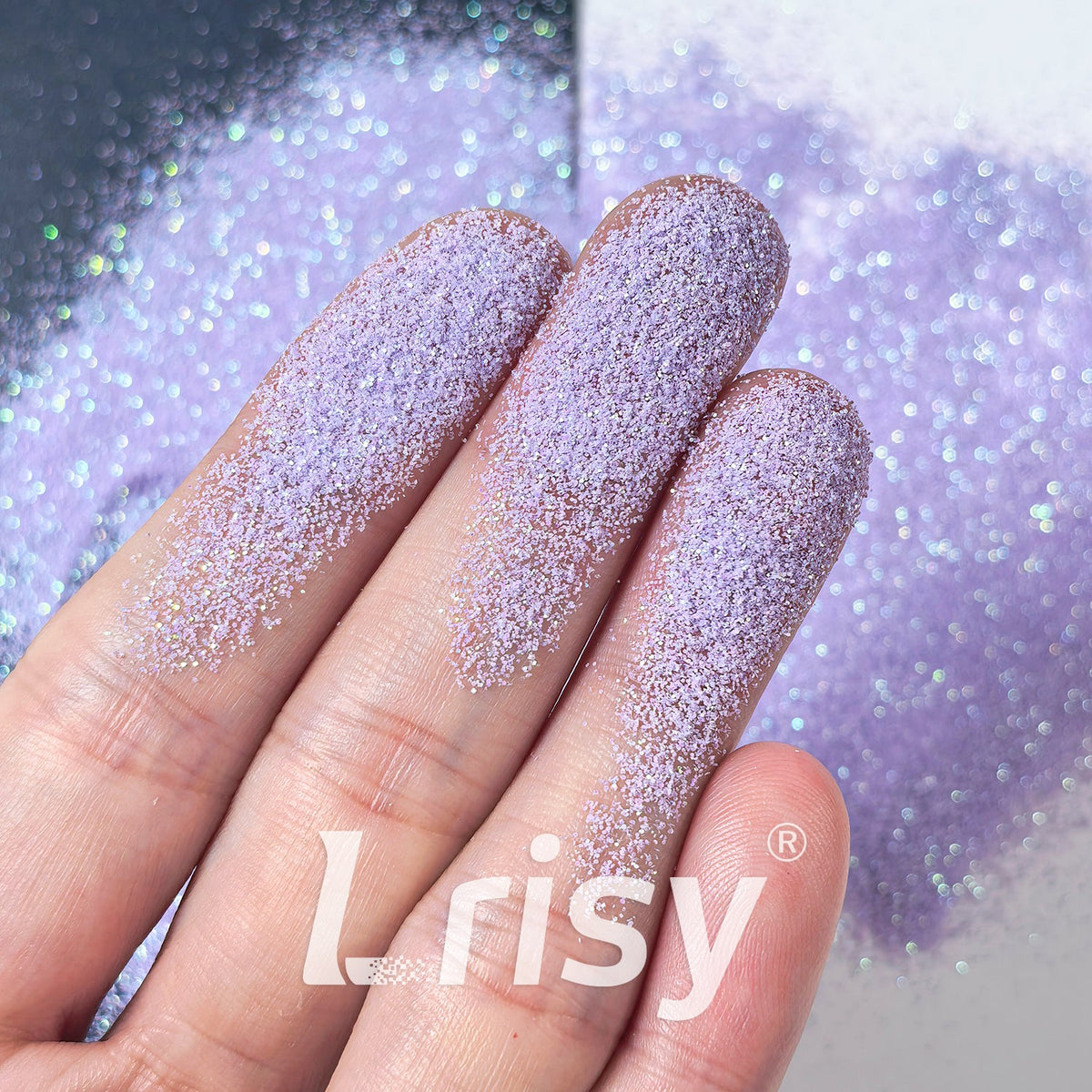
Quick Answer: Wholesale purple glitter runs $10-28/kg for standard craft-grade, $22-45/kg for cosmetic-grade, and $28-55/kg for premium finishes (iridescent purple, holographic). Factory-direct MOQs start around 500g-5kg per shade. Before ordering, vet the supplier on shade consistency and finish stability: iridescent purple's color-shift is fragile and varies between batches. Request a sample from the actual lot you'll receive. Purple is the lowest-competition color in the glitter market (median difficulty 13), which makes it the smartest wholesale bet for a new business, but only if the purple you receive is consistent.
A resin-craft brand owner found her niche in cosmic-themed resin coasters, with iridescent purple as the hero product. The first wholesale order taught the standard lesson the hard way: the iridescent purple from lot A shifted purple-to-green beautifully, while lot B's shift was flat and almost invisible. The color-shift finish is purple's signature, and its most variable spec.
The difference cost her a full production week. Coasters poured from lot A sold out; coasters poured from lot B sat in her shop with customers tilting them under the light and putting them back. She had checked price, MOQ, and lead time — everything a standard buying checklist covers — and missed the one spec that defines iridescent purple: shift consistency across batches. A reseller would have told her "they're all the same"; a real manufacturer showed her the production-run data and let her pick the lot.
Purple is the lowest-competition color in the glitter market, which makes it the smartest wholesale bet for a new business. But that advantage only works if the purple is consistent, and iridescent purple's shift is the hardest finish to source reliably. This guide covers wholesale purple glitter pricing, the shades worth stocking, MOQ reality, and a supplier vetting checklist specific to purple.
Key Takeaways
- Purple is the lowest-competition color (median difficulty 13), the smartest wholesale bet for new businesses and resellers.
- Iridescent purple's color-shift is the premium finish, and the most variable spec. Verify the shift across batches before committing.
- Wholesale pricing: $10-28/kg craft-grade, $22-45/kg cosmetic-grade, $28-55/kg premium finishes. Compare per-kg, never per-jar.
- Real MOQs start at 500g-5kg per shade, not the "no minimum" that marketplace resellers offer.
- Purple spans four shades (lavender, violet, grape, plum), each with a different market and a different margin profile.
- Always request a batch sample from the actual lot, especially for iridescent purple, where the shift varies between production runs.
"Is 'Wholesale Purple Glitter' Actually Wholesale?" — The Market Trap
The purple glitter market is crowded with repackaged retail labeled "wholesale." A reseller buys a bulk bag, splits it into jars, marks it up 4-5x, and calls it wholesale. That is not wholesaling; it is retail with a bigger container.
How to tell the difference: A genuine factory-direct supplier quotes per-kilogram, specifies MOQs per shade, and provides test documentation. A reseller quotes per-jar, has no minimum, and can't show a spec sheet. Real wholesaling moves volume at cost-plus margins; per-unit price drops as quantity rises.
Purple is especially vulnerable here: iridescent purple's color-shift is hard to verify in the jar. A flat-shift batch looks purple loose and fails on a finished product. The shift problem hides until you've already paid, and a reseller can't tell you which lot you're getting because they don't track lots.
The fix: Buy from a factory-direct manufacturer. LRISY produces glitter in-house, quotes per-weight pricing, and publishes spec data because it controls the production line. A manufacturer can show you a production run; a reseller can only show you a jar.
Wholesale Purple Glitter Pricing Benchmarks (2026)
Use these ranges to benchmark any quote. Price is the fastest early-warning signal in this market. If a quote is far below the range, the product is almost certainly not what it claims to be.
| Shade / Grade | Wholesale (per kg) | Typical Retail (per 100g jar) | Notes |
|---|---|---|---|
| Standard violet (craft) | $10 - $28 | $7 - $18 | Base color, fine to medium |
| Cosmetic-grade purple | $22 - $45 | $14 - $28 | FDA-compliant pigments |
| Lavender | $18 - $38 | $12 - $25 | Soft pastel, bridal-leaning |
| Iridescent purple | $28 - $55 | $18 - $38 | Color-shift finish, premium |
| Holographic purple | $28 - $55 | $18 - $38 | Prismatic finish, premium |
| Grape / plum | $12 - $32 | $8 - $20 | Deep shades |
How to read the table: If a supplier quotes $6/kg for "premium iridescent purple," it isn't what it claims. Real iridescent purple doesn't go below roughly $28/kg at volume. Price is your fastest early-warning signal. For the full cost breakdown including hidden fees, see the bulk glitter pricing guide.
Purple Glitter Shades Worth Stocking
Purple is four products in one color family. Which to stock depends on your end market, and each shade carries a different margin profile.
Violet — The Volume Workhorse
True, vivid purple, the most versatile all-rounder. Stock the largest quantity; it feeds general crafts, nails, and fashion. LRISY's purple glitter collection centers on this base, and it is the workhorse for a simple reason: violet sells to every lane at once, so it turns inventory faster than any other shade, and faster turnover means lower holding cost.
Iridescent Purple — The Premium Line
Color-shift finish that reads as cosmic: the top-selling premium purple. Stock a dedicated iridescent line for the galaxy-resin and festival markets. This is the margin line: the $28-55/kg price is more than double violet, but the finished products it powers (galaxy coasters, cosmic kits) sell at premium retail prices that absorb the material cost.
Lavender — The Pastel Line
Soft, romantic, bridal-leaning. Stock for the wedding and cosmetic channels. Lavender and violet look similar loose but serve completely different customers; a bridal supplier won't substitute violet for lavender, so stocking both captures two channels.
Grape / Plum — The Deep Line
Rich and dramatic. Stock for evening wear, bold fashion, and statement pieces. Grape and plum carry opacity, which makes them the shades that hold color in dark resin and on dark surfaces: a technical niche the pale shades can't serve.
MOQs and Bulk Buying: The Purple-Specific Rules
Purple MOQs follow the standard factory-direct pattern, with purple-specific considerations. Understanding the tiers keeps you from over-ordering a shade you can't move.
Typical MOQ Ranges
| Order Type | MOQ | Best For |
|---|---|---|
| Factory-direct standard purple | 500g - 5kg per shade | New businesses, stock testing, small craft lines |
| Custom colors / custom sizes | 5kg - 25kg per shade | Branded color matching, salon-scale lines |
| Private label / custom packaging | 25kg+ or negotiated annual volume | Retail jars with your label, reseller programs |
The tier tells you what the supplier is actually set up to do. A supplier whose only tier is 25kg+ is a manufacturer, not a small-batch partner; a supplier with no minimum at all is a reseller. Match the tier to your stage.
The purple-specific rule: verify the shift. For iridescent purple, order a small test batch first and verify the color-shift across the lot before scaling. The shift is the product: a flat batch is a dead inventory. Iridescent's thin-film coating is applied in a separate production step, and that step drifts between runs. A 200g test batch costs a few dollars and prevents a $500 mistake.
The strategy rule: Order fewer shades at higher quantity per shade. Purple's low competition rewards depth. Owning a shade beats thin coverage across four, and that depth builds recognition: a customer who consistently finds your violet is a repeat buyer; a customer who finds a different purple every visit is a comparison shopper.
For the full MOQ and pricing mechanics, see the bulk glitter pricing guide.
How to Vet a Purple Glitter Supplier: The Checklist
Purple-specific vetting goes beyond the standard checklist because purple's failures are finish-based. Run every candidate through these six checks before you send a PO.
- Factory or reseller? Ask for facility proof. Real manufacturers can show the plant; a reseller cannot, because you're buying production control, not just glitter.
- Per-kg quotes with MOQs? Per-jar with no minimum = reseller markup. Real wholesaling quotes per weight and scales price with quantity.
- Batch samples from the actual lot? Demand a sample from the batch you'll receive, not a marketing pack. The marketing pack is the best lot the supplier ever made; the batch you receive is the real question.
- Shift-consistency check (iridescent): Ask how the supplier guarantees the color-shift across batches. Compare two production runs. If they can't produce run data, the shift is unverified.
- Grade and certification? Cosmetic-grade for beauty resale, with FDA compliance documentation. For food-adjacent use, demand food-grade certification.
- Heat/solvent and test docs? For resin and polish buyers, the supplier must show epoxy or polish tests. A published test is the only proof the material survived the use case.
LRISY's how to vet a wholesale glitter supplier guide deep-dives each step, and the glitter sample sets let you test purple shades before committing to bulk.
How to Compare Per-Kg Pricing and Spot Hidden Fees
Per-kg price is the headline number, but it is not the whole cost. Two quotes at the same per-kg can differ by 30% in landed cost once the hidden fees are added.
The four hidden fees to ask about
- Freight and incoterms. A quoted FOB price excludes shipping; a CIF price includes it. Compare like-for-like, and ask for the freight quote in writing before you commit.
- Color-matching fees. Custom purple shades often carry a one-time development charge of $50-300. Confirm whether "custom color" means a standard off-the-shelf shade or a paid match.
- Sample vs production differences. The sample you approve may come from a premium lot while production ships from a different run. Put in writing that production must match the approved sample.
- Minimums on mixed loads. Some suppliers quote a low per-shade MOQ but require a higher total order across shades. Ask for the aggregate minimum before you add five purple shades to the cart.
Iridescent purple's premium price makes it the line most likely to hide a freight or color-match fee in the margin. The bulk glitter pricing guide walks through unit costs, MOQs, and the hidden-fee math line by line, and the bulk glitter cost per pound guide gives you the conversion to compare across suppliers.
The Purple Ordering Workflow: RFQ to QC
Wholesale purple glitter is not a one-step purchase; it's a four-step workflow. Skipping any step is where the margin leaks.
Step 1 — RFQ (request for quotation)
Send a written RFQ that names the exact shade, finish, particle size, and grade you want, "violet, metallic, 0.015", craft-grade", plus the quantity. A vague RFQ invites a vague quote. The supplier's response tells you whether they can hold a spec at all; if the quote ignores your particle size, walk away.
Step 2 — Batch sample
Order a sample from the actual lot you'll receive, and test it in your own application: pour it in resin, drop it in polish solvent, hold it under direct light. A glitter that passes the "looks good in a bag" test can still bleed in resin or turn grey in acetone. Your use case is the only test that matters.
Step 3 — Production with approved sample in hand
When production starts, reference the approved sample in writing. Ask the supplier to confirm the production run will match it, because without a written reference, "production" can ship from a different, cheaper lot and still be called the same product.
Step 4 — QC on arrival
When the order lands, re-test a small portion against your approved sample before you sell it down. Compare shade, shift, and particle size. QC on arrival matters because a mismatch found at receiving is a return; a mismatch found after a customer complaint is a refund plus a lost review.
This four-step loop is the reason factory-direct pricing looks cheap: the savings come from you doing the verification the retail markup would have paid for.
The Iridescent Shift Problem: Why Color-Shift Verification Matters
Iridescent purple is the highest-margin finish in the purple family, and the one most likely to fail. The color-shift comes from a thin-film interference coating, and that coating is applied in a separate manufacturing step that drifts between runs.
The three shift failures
- Flat shift: The film is too thin or poorly applied: the glitter reads as plain purple with no color-change. The customer sees a $55/kg material performing like a $10 one.
- Wrong shift: Purple-to-green instead of purple-to-blue, or a muddy transition that reads as grey. The color pairing matters more for iridescent than any solid shade.
- Inconsistent lot: Half the batch shifts, half doesn't. Products made from the same order look different, and customers notice.
The verification method: order a 200-500g test batch from the actual lot, hold it under direct light at three angles, and compare it against a reference piece. Then repeat with a second production run and confirm the shift matches. This is the only reliable way to guarantee shift consistency. No spec sheet can substitute for seeing two runs side by side.
Why this is a wholesale issue, not a retail one: a retail buyer rejects one jar; a wholesaler rejects a production week. One verified lot before scale is the cheapest insurance in the purple business.
Buying Strategy by Business Model
Map your purple order to your end market. The right shade mix depends on what you actually sell.
Cosmic / Resin Business
Stock fine iridescent purple in depth, the galaxy workhorse. Add chunky purple for geodes. Confirm heat ratings for resin, because the cosmic line sells as a set, and iridescent is the base SKU every galaxy product reorders.
Nail & Beauty Business
Stock cosmetic-grade violet and lavender in 0.004"-0.015". Iridescent purple is the premium festival line. Why: grade and particle size are safety specs for nails: the supplier must show FDA compliance and solvent tests.
Craft / Fashion Business
Stock violet for volume and grape/plum for the dramatic fashion lane. Lavender feeds the bridal-adjacent market. Fashion resale rewards depth in the shades your customers can see, not breadth across all four.
New / Startup Business
Purple is the lowest-competition color: the smartest entry point. Start with violet and iridescent purple, the two volume-and-margin anchors, then add a third shade only after your product sells. Start narrow because inventory that doesn't turn is the #1 killer of new glitter businesses.
Seasonal Timing: When to Buy Purple Glitter
Purple glitter demand is not flat; it spikes around specific calendar moments, and buying ahead of the spike is where the margin lives.
- Spring (Feb-Apr): Lavender and pastel purple surge with bridal season and Easter-themed crafts. Buy lavender 6-8 weeks ahead of spring.
- Halloween (Sep-Oct): Purple is the second-most-used Halloween color after black: cosmic and witch themes drive deep purple and iridescent demand. Buy by late summer for November events.
- Festival season (May-Aug): Iridescent purple peaks with music-festival and cosmic-look demand in nails and makeup. Stock the premium line before the season opens.
- Year-round workhorse: Violet sells every month: it's the shade that carries your inventory when the seasonal spikes flatten.
Seasonal buying beats just-in-time because factory-direct MOQs and lead times mean a rush order costs more and arrives late. Ordering the seasonal shades early locks in the lower price and guarantees stock for the spike, and it spreads your cash flow across the year instead of one concentrated purchase. A simple 12-month calendar with your target spikes marked on it is enough to schedule every order for the year ahead.
FAQ: Wholesale Purple Glitter
How much does wholesale purple glitter cost?
Standard violet runs $10-28/kg; cosmetic-grade $22-45/kg; premium finishes (iridescent, holographic) $28-55/kg. Compare per-100g, never per-jar.
What is the minimum order quantity for purple glitter?
Factory-direct MOQs typically start at 500g-5kg per shade. Custom colors, sizes, and packaging require 5kg-25kg+.
Why is iridescent purple more expensive?
The color-shift finish uses a thin-film interference coating, a premium manufacturing step. It's the highest-margin purple finish and the hardest to source consistently.
Is purple glitter a good wholesale bet for a new business?
Yes, purple has the lowest median competition of all glitter colors. It's the smartest entry point for new resellers and craft brands.
How do I verify iridescent purple quality?
Order a small test batch and check the color-shift under direct light before scaling. Compare the shift across two production runs to confirm consistency.
What purple glitter should I stock for a new business?
Start with fine violet (500g-1kg) and iridescent purple (200-500g), then add lavender or grape based on your market. Scale after your product sells.
How can I tell if a purple glitter supplier is a reseller?
A genuine factory-direct supplier quotes per-kilogram, specifies MOQs per shade, and provides test documentation. A reseller quotes per-jar, has no minimum, and can't show a spec sheet.
Which purple glitter shades are worth stocking?
Violet is the volume workhorse, iridescent purple is the premium margin line, lavender serves the bridal and cosmetic channels, and grape/plum serve evening and bold fashion.
📖 Reading Next
Continue exploring the LRISY glitter library:
- Bulk Glitter Pricing Guide — unit costs, MOQs, and hidden fees line by line.
- How to Vet a Wholesale Glitter Supplier — the certification and QA checklist.
- Bulk Glitter Buying Guide — sizes, finishes, and MOQ math at wholesale scale.
- How to Choose a Bulk Glitter Supplier — comparing supplier quality and reliability.
- Wholesale Glitter Buying Guide — the full procurement process for businesses.
Conclusion
Wholesale purple glitter is the smartest color bet in the market: the lowest competition, a wide-open field, and a premium iridescent finish that commands top margins. But the advantage only works if the purple is consistent: shade-consistent for solids, shift-consistent for iridescent. The fix is supplier discipline: per-kg quotes with real MOQs, batch samples from your actual lot, and finish-verification tests. Get purple right and it's the easiest color to win; get the shift wrong and it's the most visible.
The difference between a profitable purple line and a dead inventory is one verified lot. Price catches the obvious fakes, but only a batch sample catches the flat-shift iridescent that looks right in the jar and fails on the product. That single test step is the cheapest insurance in the wholesale glitter business. If you only restock a standard violet from a supplier you already trust, most of the checklist above does not apply, so reorder and move on; the verification ritual earns its cost where the finish can fail: iridescent purple, first orders, and new suppliers.
Ready to source wholesale purple glitter from a real factory? Browse LRISY's purple glitter collection, compare the iridescent range, and start with a sample set to verify purple consistency before your first bulk order.

Leave a comment
All comments are moderated before being published.
This site is protected by hCaptcha and the hCaptcha Privacy Policy and Terms of Service apply.