
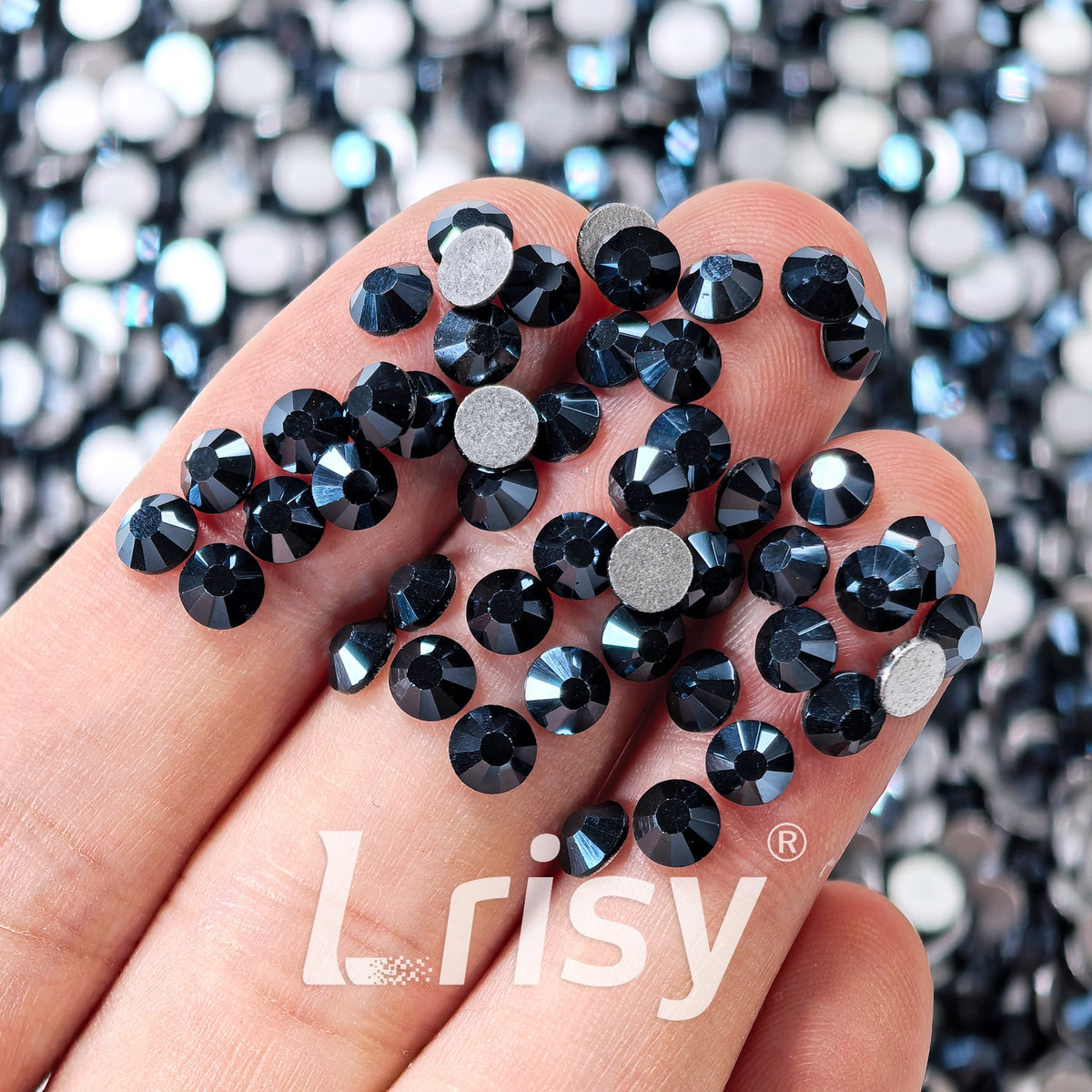
Black rhinestones are manufactured glass or crystal stones with a dark base and reflective foil backing. They come in five primary shades (jet black, black diamond, black crystal, black AB, and smoky black) and three backing types: hot-fix, sew-on, and flat-back (non-hot-fix). Buying black rhinestones bulk wholesale saves 30–60% over retail, with minimum orders typically starting at 100 gross (14,400 stones). For apparel decoration, SS10 and SS16 are the most popular sizes. Czech (Preciosa) and Chinese manufacturers supply the vast majority of the global market.
Black Rhinestones Bulk: The Complete Guide to Types, Shades, and Sourcing (2026)
Black rhinestones rank as the second most popular rhinestone color worldwide, trailing only crystal clear. But unlike clear stones, black rhinestones have a reputation problem.
Buy the wrong ones and they look like dull plastic discs. Apply them incorrectly and they fall off after one wash. Order from the wrong supplier and you get a box of chipped, uneven stones with foil backing that flakes before you even use them.
I learned this the hard way.
The Dress That Almost Didn't Make It
A costume designer had six weeks to deliver a state-pageant evening gown. The client wanted a constellation pattern: thousands of black rhinestones across a midnight-blue bodice. The designer had been buying retail packs at $3.50 per gross. She calculated the cost for 2,200 stones and nearly dropped the project. The rhinestones alone would run over $7,000.
She called every supplier she could find. A vendor at a trade show finally showed her black rhinestones bulk pricing: $1.25 per gross at 200 gross minimum. Her next dress cost $1,800 in stones, not $7,000. That single discovery turned a loss-making project into a profitable one. She now runs a side business supplying wholesale stones to other pageant designers.
Her story is not unusual. The difference between retail and wholesale pricing on black rhinestones wholesale is massive, 30 to 60 percent savings, but finding a reliable supplier who sells actual quality stones at those prices takes work. That is exactly what this guide will help you do.
Can't Find Black Rhinestones That Actually Sparkle?
If you have ever opened a pack of black rhinestones expecting deep, liquid shine and instead found flat, lifeless discs, you are not alone. The problem is almost always one of three things: the wrong shade, poor foil backing, or a low-grade stone.
Black rhinestones work differently from clear or colored stones. Clear stones transmit light and let the full brilliance of the cut show through. Black stones absorb most light before it can bounce back. The bit of light that does return comes entirely from the metallic foil backing on the flat side of the stone. (For background, Wikipedia's history of rhinestones traces how these glass stones evolved from 18th-century rock crystal imitations along the Rhine River into the precision-cut manufactured stones used today.)
Copper backing produces a warm, fiery sparkle, the kind that looks dramatic on stage or in direct light. Silver backing yields a cooler, more understated gleam that works better for subtle daytime jewelry. If your stones look dull, check the backing first. Many budget-grade stones skimp on foil quality, applying a thin metallic layer that flakes off or reflects poorly.
The best black diamond rhinestones use a high-luster copper backing applied in a thick enough layer to reflect light consistently across every stone. When you buy black rhinestones bulk from a reputable supplier, this is the quality marker to check first: not the cut, not the color depth, but the foil.
Black Rhinestone Shades: Which One Is Right for Your Project?
Not all black rhinestones are the same shade. Manufacturers produce several distinct variants, each with a different visual effect, application, and price point. Choosing the wrong one is one of the most common sourcing mistakes.
| Shade | Appearance | Light Behavior | Best For | Popularity |
|---|---|---|---|---|
| Jet Black | Deepest, most opaque black | Absorbs nearly all light, minimal sparkle | Gothic, punk, high-contrast formal designs | Medium |
| Black Diamond | Dark grey/black with faceted reflection | Copper/silver foil reflects through facets — visible sparkle | Most all-purpose: costumes, jewelry, apparel | Highest |
| Black Crystal | Translucent dark grey base | Some light passes through, soft glow, not sharp flash | Bridal, evening wear, subtle accents | High |
| Black AB | Aurora Borealis coating over dark base | Rainbow iridescence, shifts color at different angles | Festival wear, stage costumes, statement jewelry | Growing |
| Smoky Black | Brownish-grey undertone | Moderate reflection, warm undertone | Vintage, bohemian jewelry with gold settings | Niche |
Jet Black
Jet black is the darkest and most opaque option. It absorbs nearly all light and shows minimal sparkle. Designers choose it for gothic, punk, and high-contrast formal work where they want the shape of the stone without the shine. The effect is matte and serious: closer to onyx than to crystal. Jet black stones work well on leather, dark velvet, and matte fabrics where a reflective stone would compete with the material.
Black Diamond
This is the most popular finish for black rhinestones bulk ordering. The stone is cut with a full faceted underside and a copper or silver foil backing. Light enters the top, reflects off the foil, and exits through the facets, producing visible sparkle despite the dark color. If you are ordering for general-purpose use and are unsure which shade to pick, black diamond is the safe choice. It accounts for roughly 40 percent of all black rhinestone wholesale volume.
Black Crystal
Black crystal rhinestones use a slightly translucent dark grey base rather than true black. This allows some light to pass through the stone, creating a soft, liquid glow rather than a sharp flash. These stones are common in bridal and evening wear where subtlety matters. They photograph well because the translucence catches studio light. Black crystal rhinestones are also frequently used in nail art, where a softer shimmer complements natural nail tones without overwhelming them.
Black AB
Black AB (Aurora Borealis) applies a thin iridescent coating over a black or dark grey glass base. The coating produces rainbow color shifts on the stone surface: greens, blues, pinks, and golds that appear as you move the stone in the light. Black AB rhinestones shift color at different angles, making them popular for festival wear and stage costumes where movement is part of the design. The AB coating is vacuum-deposited and durable enough to withstand heat application, though testing a small batch before full production is always wise.
Smoky Black
Smoky black sits between crystal and jet black. It has a brownish-grey undertone that pairs naturally with gold settings, far better than true black does. Vintage and bohemian jewelry lines frequently use smoky black stones. The warmth of the undertone softens the overall look, making it feel aged and intentional rather than stark.
Why Your Black Rhinestones Keep Falling Off (And How to Fix It)
You applied them carefully. They looked perfect. Then one wash — or one wear — and stones start dropping. This is the most common complaint we hear from customers who buy black rhinestones wholesale for the first time.
The fix is almost always in the application method, not the stone itself.
Hot-Fix: Right Temperature, Right Pressure
Hot-fix rhinestones have a heat-activated thermoplastic glue pre-applied to the flat back. When heated to the correct temperature, 170–190°C (338–374°F), the glue melts and bonds the stone to the fabric. Applied correctly, the bond is permanent through repeated washing. (Industry resources like Heat Press Guide offer general temperature guidelines that apply to rhinestone transfer work.)
Two mistakes cause most failures:
- Too cold: The glue does not fully melt. The stone bonds weakly and falls off after light wear. Solution: preheat your heat press for at least 10 minutes and verify the temperature with an infrared thermometer.
- Too short: Even at the right temperature, the glue needs 20–30 seconds under pressure to flow into the fabric weave. Rushing this step is the number-one cause of stone loss. Set a timer. Do not guess.
For detailed guidance on application, visit our hot-fix rhinestones collection for size-specific temperature charts.
Sew-On: The Labor-Intensive but Permanent Solution
Sew-on rhinestones have two or four pre-drilled holes for hand or machine stitching. They cost more per stone because each one requires manual labor to affix, but the bond is mechanical: no glue, no heat, no risk of peel failure. Sew-on stones are the right choice for high-end garments, delicate fabrics like silk or chiffon that cannot withstand heat, and any project where stone loss is simply not acceptable.
Flat-Back (Non-Hot-Fix): Use the Right Adhesive
Non-hot-fix flat-back stones require a jewelry-grade adhesive. E6000 and Gem-Tac are the industry standards. (E6000's technical data sheet lists adhesion specifications for various substrates.) Avoid generic craft glue, superglue, or hot glue from a hardware store: these either dry brittle (stones pop off when the garment flexes) or remain tacky (they attract dust and lint).
When ordering flat-back rhinestones for jewelry or nail art, match the adhesive to the surface material. E6000 works on metal, glass, and most plastics. Gem-Tac is better for fabric and porous surfaces because it remains slightly flexible after curing.
Why Black Diamond Rhinestones Outperform Every Other Finish
Walk into any rhinestone supply shop and ask what sells best. The answer is black diamond — consistently, across every size bracket and every customer segment. The reason is optical physics, not just fashion trends.
Black diamond rhinestones use a dark grey or black glass base combined with a full metallic foil backing. The foil sits behind the glass, not on top of it. Light enters through the crown of the stone, travels through the glass, hits the reflective foil, and bounces back out through the precisely angled facets. The result is sparkle — real, visible sparkle — from a stone that still reads as black at a distance.
No other black finish achieves this balance. Jet black absorbs too much light. Black crystal lets too much light pass through the sides instead of reflecting it back. Black AB relies on a surface coating that can wear off over time. Black diamond's effect comes from the internal structure and will last as long as the foil backing stays intact; which, on AAAA-grade stones, means years.
For bulk buyers, black diamond rhinestones wholesale also offer the widest size availability and the most competitive pricing because manufacturers produce them at higher volumes than any other black finish.
Your Black Rhinestones Bulk Buying Cheat Sheet: Sizes, Grades, and Pricing
Buying black rhinestones wholesale for the first time is intimidating. Minimum order quantities, unfamiliar sizing systems, and a wide quality range make it easy to overpay or under-order. Here is the cheat sheet I wish someone had given me.
Sizing: The SS System Explained
Rhinestone sizes follow the SS (Stone Size) system. Each SS number corresponds to a precise millimeter diameter. The chart below shows the sizes most relevant to bulk ordering:
| SS Number | Diameter (mm) | Common Use | Wholesale Volume Share |
|---|---|---|---|
| SS3 | 1.3 | Micro details, nail art accents | <5% |
| SS5 | 1.7–1.8 | Nail art, detailed patterns | 5–8% |
| SS10 | 2.7–2.8 | All-purpose, most popular size | ~30% |
| SS16 | 3.8–4.0 | Dance costumes, jewelry pendants | ~30% |
| SS20 | 4.5–4.6 | Centerpiece stones, bold designs | 10–15% |
| SS30 | 5.5–5.6 | Large centerpieces, costume jewelry | 5–8% |
| SS34+ | 6.0+ | Statement pieces, embellishments | <5% |
When ordering black rhinestones bulk, SS10 and SS16 together account for roughly 60% of wholesale volume. Most suppliers stock these sizes in every finish at the lowest per-unit cost. If you are starting a new project and do not know which size to order, start with SS16 for garments and SS10 for jewelry: those two sizes cover 80% of common applications.
Grading: What AAAA, AAA, and AA Actually Mean
Rhinestone grading is not standardized across the industry, but reputable suppliers use a consistent three-tier system:
| Grade | Facet Alignment | Color Consistency | Foil Quality | Typical Reject Rate | Best For |
|---|---|---|---|---|---|
| AAAA (Top) | Perfect, sharp facets | Uniform across all stones | Flawless, thick metallic layer | <2% | High-end jewelry, pageant wear, production runs |
| AAA (Medium) | Minor variation | Slight shade differences | Good, occasional thin spots | 5–8% | Garments, dance costumes, general use |
| AA (Economy) | Noticeable imperfections | Visible variation across batches | Thin foil, may flake | 10–15% | Practice, prototypes, low-cost production |
When buying black rhinestones bulk, always request a grading certificate and a physical sample card before placing a large order. The sample card lets you inspect facet sharpness, color consistency, and foil coverage under natural and direct light. Any supplier who hesitates to provide samples should be treated with caution.
Pricing: What to Expect at Wholesale Volume
| Source | Price Per Stone (SS10) | Minimum Order | Quality Tier |
|---|---|---|---|
| Czech (Preciosa) | $0.12–$0.25 | 50–100 gross | Premium — industry benchmark |
| Austrian (Swarovski) | $0.30–$0.80 | Limited (discontinued line) | Luxury — existing stock only |
| Chinese (Top-Tier) | $0.05–$0.12 | 100–500 gross | Good — lead-free crystal |
| Chinese (Budget) | $0.02–$0.05 | 100–1,000 gross | Variable — soda-lime glass |
One gross = 144 stones. A standard bulk minimum order of 100 gross contains 14,400 stones. At $0.08 per stone (top-tier Chinese), that is $1,152 for enough stones to cover dozens of garments. At $0.35 retail, the same quantity would cost $5,040. The savings scale dramatically with volume.
Where to Source Black Rhinestones: Supplier Comparison
Czech Glass Rhinestones (Preciosa)
Czech glass rhinestones from Preciosa are widely considered the industry benchmark for quality. The facets are sharp and uniform. The backing foil is thick and durable; it does not flake or peel after washing. The color range includes twelve distinct black variations, more than any other manufacturer offers. Czech stones cost more — typically $0.12–$0.25 per stone depending on size, but the consistency reduces waste significantly. For production runs where every stone must match perfectly, Preciosa is worth the premium. (Preciosa's official rhinestone catalog provides detailed specifications on their black crystal formulations and facet geometries.) Browse our flat-back rhinestones collection for Czech-sourced options.
Austrian Crystal Rhinestones (Swarovski)
Swarovski set the luxury standard for decades. The company discontinued its crystal components business in 2021 (Reuters reported the restructuring that led to the shutdown of the components division), which means existing stock and licensed resellers are now the only supply channels. Prices range from $0.30–$0.80 per stone, and availability depends on remaining inventory. For most bulk buyers, the combination of high cost and uncertain supply makes Swarovski impractical for ongoing production. Use it for special projects where brand recognition matters: the Swarovski name still carries weight with discerning clients.
Chinese-Manufactured Rhinestones
Chinese manufacturers dominate the black rhinestones wholesale market by volume. Quality varies dramatically between factories. Top-tier Chinese suppliers use lead-free crystal formulations that approach Czech quality at half the price — sometimes less. Budget-tier options use soda-lime glass (the same material used in standard window glass and bottles, as Britannica notes), which has noticeably less brilliance, scratches more easily, and often has thinner foil backing that deteriorates faster.
The key to sourcing from China is supplier verification. Request samples. Check the foil adhesion by rubbing a stone against a white cloth — if you see metallic dust, the foil is too thin. Compare facet sharpness under magnification. A reputable Chinese supplier will provide grading certificates and accept returns on defective batches. One that refuses samples or offers only "factory direct ungraded" stones is taking shortcuts.
Common Applications: Where Black Rhinestones Shine (Literally)
Apparel Decoration
Apparel decoration drives the highest volume demand for black rhinestones wholesale purchases. Dance costumes, cheerleading uniforms, and pageant gowns rely on black stones for contrast against bright fabrics. Evening gowns use black crystal rhinestones as subtle accents along necklines and waist seams. The contrast between matte fabric and reflective black stones creates visual depth that flat embroidery or screen printing cannot match. (The Costume Society documents how rhinestone-embellished costumes have evolved in theatrical and competitive dance contexts.)
For garments, hot-fix stones are the standard because they apply quickly in production. A single heat press can set hundreds of stones in one cycle. Browse hot-fix rhinestones for sizes optimized for garment work.
Nail Art
Nail art is a rapidly growing segment for black rhinestones. Sizes SS3 to SS6 are applied as single accent stones or arranged in geometric patterns. The contrast against nude, white, or red polish creates a high-impact look with minimal effort. Black AB rhinestones are especially popular in nail art because the iridescent coating catches light as the hand moves, creating dimension that flat stones cannot achieve. (For application techniques, NAILS Magazine regularly features rhinestone nail art tutorials and product reviews.)
Jewelry Design
Jewelry designers use black diamond rhinestones as diamond simulants in costume jewelry. The stones are set in sterling silver, gold-plated, or rhodium-finished settings. Earrings, pendants, and cocktail rings with black stones sell year-round; they are not seasonal like pastels or holiday-specific colors. For jewelry applications, pointed-back rhinestones offer the best fit in prong settings. See our pointed-back rhinestones for setting-compatible options.
Home Decor and Accessories
Black rhinestones appear on phone cases, handbags, belts, and even furniture trim. The trend toward maximalist decor has increased demand for embellished home goods. Flat-back stones in larger sizes (SS20 and up) are glued onto frames, mirror borders, and decorative boxes.
Compatibility Guide: Which Black Rhinestone for Which Material?
| Material | Best Stone Type | Best Application Method | Notes |
|---|---|---|---|
| Cotton, Polyester | Hot-fix, any shade | Heat press, 170–190°C, 20–30s | Most forgiving substrate |
| Silk, Chiffon | Sew-on, black diamond or crystal | Hand stitch | Heat damages delicate fabric |
| Denim | Hot-fix, jet black | Heat press, 180°C, 25s | Use firm pressure due to thick fabric |
| Leather | Flat-back, any shade | E6000 adhesive | Do not heat — damages leather finish |
| Metal | Flat-back, pointed-back | Epoxy or jewelry glue | Pointed back fits prong settings |
| Natural Nails | Flat-back, SS3–SS6 | Nail glue or gel top coat | Avoid hot-fix glue layer |
| Acrylic Nails | Flat-back, black AB or diamond | Embed in gel layer before curing | AB coating catches light beautifully |
| Glass, Ceramic | Flat-back, any shade | Epoxy resin | Clean surface thoroughly first |
Care and Maintenance: Make Your Black Rhinestones Last
Black rhinestones require different care than light-colored stones. The dark color shows dust, oil, and fingerprints more readily. Here is how to keep them looking their best:
- Clean gently: Wipe with a soft, dry cloth after each wear. For deeper cleaning, use a slightly damp microfiber cloth — never submerge garments with hot-fix stones.
- Avoid ultrasonic cleaners: The vibration can loosen the foil backing, especially on budget-grade stones. Once the foil detaches, the stone loses all reflective quality.
- Store flat-back stones in compartmentalized cases to prevent scratching. Black stones show surface scratches more visibly than clear stones.
- Hot-fix garments should not be dry-cleaned. The dry-cleaning solvents degrade the thermoplastic glue. Turn garments inside out before machine washing on a gentle cycle with cold water.
- Sew-on stones can be hand-washed carefully. Check thread integrity after each wash: a loose stone puts stress on adjacent stitches.
FAQ: Black Rhinestones — Everything Else You Need to Know
What is the difference between black diamond and black crystal rhinestones?
Black diamond rhinestones use a dark grey or black glass base with metallic foil backing that reflects light through the facets, producing visible sparkle. Black crystal rhinestones use a translucent grey base that allows some light to pass through the stone itself, creating a softer glow with less flash. For stage costumes and statement jewelry, choose black diamond. For bridal and evening wear, choose black crystal.
How many black rhinestones come in a gross?
One gross equals 144 stones (12 dozen). Wholesale pricing is typically quoted per gross. A standard black rhinestones bulk minimum order of 100 gross contains 14,400 stones. The term comes from the old French "grosse" (twelve dozen) and has been the standard unit in the rhinestone industry for over a century.
Can black AB rhinestones be applied with a heat press?
Yes. Black AB rhinestones with hot-fix backing can be heat-pressed at 170–190°C for 20–30 seconds. The AB coating is applied via vacuum deposition and is durable enough to withstand heat application. However, we recommend testing a small batch first; some lower-quality AB coatings may discolor or dull under high heat.
Are black rhinestones real gemstones?
No. Black rhinestones are manufactured glass or crystal. They are made from glass (soda-lime or lead crystal) that is precision-cut, polished, and backed with reflective metallic foil to create the appearance of light reflection. They are not natural gemstones: the Gemological Institute of America (GIA) classifies manufactured glass stones as simulants rather than gem materials — though high-quality black diamond rhinestones are often used as diamond simulants in costume jewelry.
What size black rhinestones should I buy for dance costumes?
SS16 (4.0mm) is the standard size for dance and cheerleading costumes. It offers enough visual weight to read from stage while remaining light enough for garment construction. Most black rhinestones wholesale buyers start with SS16 and add SS20 for accent stones on collars, cuffs, and hemlines.
Do black rhinestones fade over time?
The glass itself does not fade; it is color-stable indefinitely. The foil backing, however, can deteriorate with moisture, heat, or chemical exposure. Proper storage in a dry, room-temperature environment and gentle cleaning will preserve the appearance for years. AAAA-graded stones from Czech or top-tier Chinese manufacturers maintain their luster significantly longer than budget-grade stones with thin foil layers.
Can I mix shades of black rhinestones in one project?
Absolutely. In fact, mixing jet black, black diamond, and black AB stones in a single garment creates depth that a single shade cannot achieve. Use jet black as a base field, black diamond for highlight areas where light hits directly, and black AB sparingly for accent points that catch movement. This three-shade approach is common in competition costumes and high-end evening wear.
What is the minimum order for black rhinestones bulk?
Minimum order quantities vary by supplier. Direct-from-factory orders typically start at 100 gross (14,400 stones). Some wholesalers offer smaller minimums (10–50 gross) at slightly higher per-unit prices. LRISY offers flexible quantities — check our FAQ page for current minimums and pricing tiers.
Reading Next
- Rhinestone Sizes Complete Guide: SS5 to SS48 Explained
- Hot-Fix vs. Sew-On Rhinestones: Which Application Method Is Right for You?
- Rhinestone Grading Guide: Understanding AAAA, AAA, and AA Quality Tiers
- Wholesale Rhinestones: A Beginner's Guide to Buying in Bulk
- Czech vs. Chinese Rhinestones: Quality, Price, and Sourcing Compared
Glossary of Black Rhinestone Terms
| Term | Definition |
|---|---|
| Black AB (Aurora Borealis) Rhinestone | A black or dark grey rhinestone coated with an iridescent layer that produces rainbow color shifts. The coating is applied via vacuum deposition after cutting. |
| Black Diamond Rhinestone | A dark-toned rhinestone with full faceting and metallic foil backing designed to maximize light reflection. Contains no actual diamond material, the term refers to the cut pattern and visual effect. |
| Black Crystal Rhinestone | A translucent dark grey rhinestone that allows partial light transmission through the glass base. Produces a soft glow rather than a sharp flash. |
| Foil Backing | The metallic layer applied to the flat side of a rhinestone that reflects light back through the facets. Copper produces warm reflection; silver produces cool reflection. Foil quality is the primary differentiator between grade tiers. |
| Gross | A unit of measurement equal to 144 pieces (12 dozen). Industry-standard unit for pricing and ordering rhinestones in wholesale quantities. |
| Hot-Fix Rhinestone | A rhinestone with pre-applied thermoplastic glue on the flat back. Activates at 170–190°C, bonding the stone to fabric. Preferred format for apparel decoration at scale. |
| Jet Black Rhinestone | The darkest and most opaque black rhinestone variety. Absorbs nearly all light with minimal sparkle. Preferred for gothic and formal designs. |
| SS (Stone Size) | The standardized sizing system for rhinestones. Each SS number maps to a precise millimeter diameter, from SS3 (1.3mm) to SS48 (8.1mm) and beyond. |
| Sew-On Rhinestone | A rhinestone with pre-drilled holes (two or four) for hand or machine stitching onto fabric. More labor-intensive but works with delicate fabrics that cannot take heat. |
Ready to buy wholesale rhinestones? LRISY offers factory-direct pricing on wholesale bulk rhinestones with fast international shipping. Browse our flat back, pointed back, hotfix, and colors AB collections for all your needs. Free shipping on qualifying orders worldwide.

Leave a comment
All comments are moderated before being published.
This site is protected by hCaptcha and the hCaptcha Privacy Policy and Terms of Service apply.