
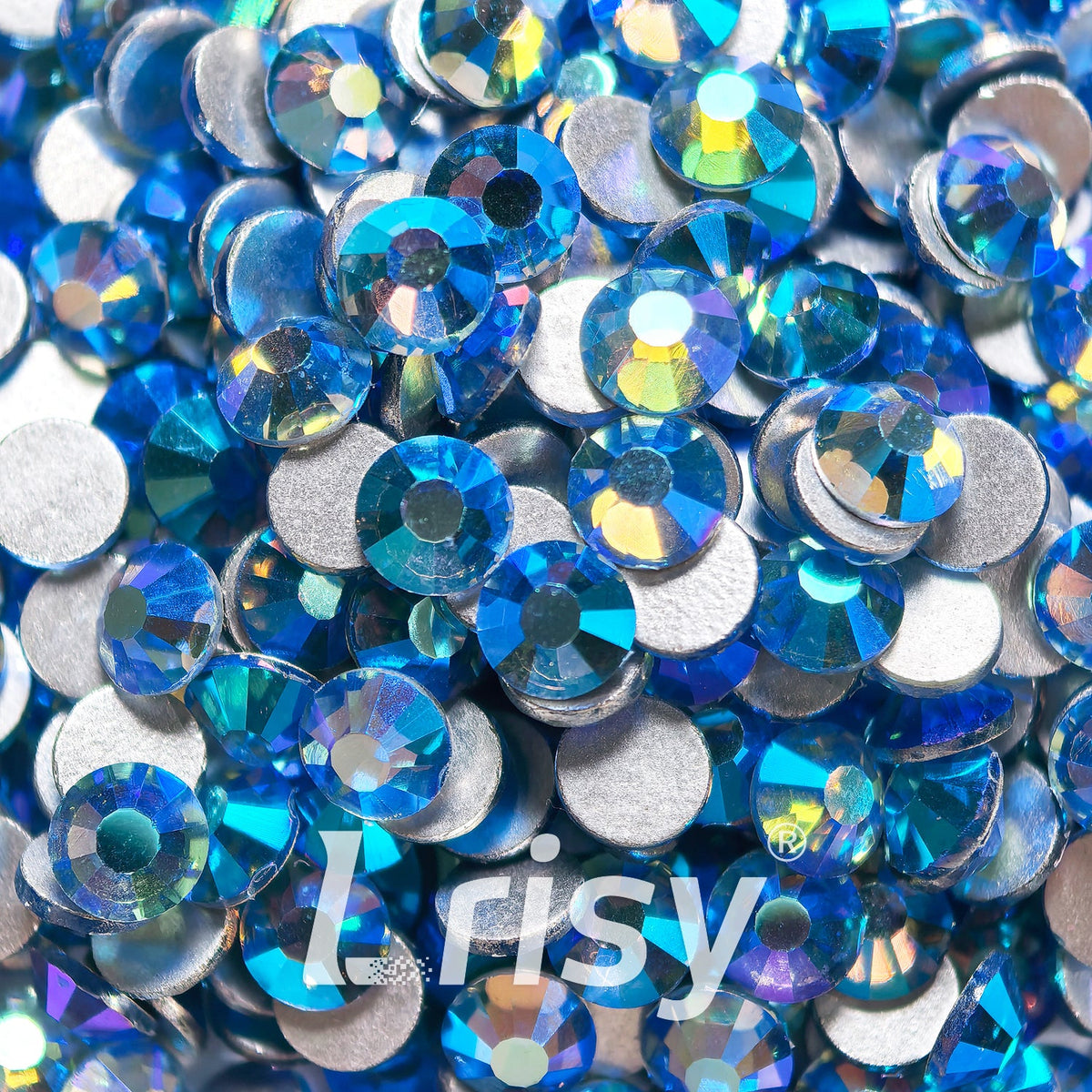
Quick Answer: Czech crystal rhinestones are precision-cut glass stones from the Bohemia region of the Czech Republic, manufactured predominantly by Preciosa. They deliver 85–90% of Swarovski's brilliance at 30–50% lower cost, using optical crystal glass with 24–32% lead oxide or lead-free equivalents. With facet tolerances of ±0.02mm and galvanic baked-on back coatings, they outperform Chinese rhinestones in durability and light performance while remaining affordable for volume production. The three main product lines serve different segments from bridal to swimwear alternatives: Preciosa Classic (leaded), Preciosa VIVA (lead-free, 32 facets), and Preciosa Briolette (teardrops).
The lead designer at a New York bridal atelier producing 900 custom gowns a year had a problem that no amount of dress sketching could solve. She had always specified Swarovski crystals for every bodice, belt, and veil. Her brides expected the sparkle; they paid for the sparkle. Then her procurement team delivered unwelcome news: Swarovski had raised prices by 18% across their entire crystal portfolio. Her per-gown stone cost was about to jump from $47 to $55. On 900 gowns annually, that was $7,200 in added expense, before the markup she would have to pass to brides who were already price-sensitive.
The designer did what any pragmatic designer would do. She ordered sample cards from three alternative suppliers, sewed test stones onto muslin swatches, and staged an unscientific but brutally honest test. She invited five senior seamstresses, two photographers, and a bridal consultant into her studio. She dimmed the lights, aimed a single spotlight at the swatches, and asked them to rank the stones by sparkle — without knowing which was which.
The result surprised her. The Preciosa VIVA stones — a lead-free Czech crystal line she had barely heard of — ranked within a hair of Swarovski in every tester's assessment. The photographers could not tell the difference under flash. The seamstresses preferred the VIVA stones because their galvanic back coating laid flatter against the fabric. And the cost? The switch saved 48% on stone costs across her entire 2025 collection. Not a single bride complained.
That is the story of Czech crystal rhinestones in 2026. They are not a compromise. They are a calculated upgrade in value, and understanding them is the difference between overpaying for a brand name and engineering the exact sparkle your product needs at the price your margin demands.
In this guide, you will learn exactly what makes Czech crystal rhinestones different, how to authenticate them, which Preciosa line fits your application, and how to source them without getting burned by counterfeits. Whether you manufacture bridal wear, costume jewelry, embroidered apparel, or home decor, the information here will save you money without sacrificing quality.
Your Challenge: Finding Premium Sparkle Without the Premium Price
If you are reading this guide, you have likely encountered one of the following frustrations. You love the brilliance of Swarovski but your margin sheet cannot absorb another price increase. You have tried cheap Chinese rhinestones and watched customers return pieces because the stones went dull after a few wears. Or you have heard "Czech crystal" thrown around as a marketing term and need to separate genuine quality from hollow claims.
These are the real pain points that drive buyers toward Czech crystal rhinestones, and the rest of this guide is built around solving each one with verifiable facts, not hype.
| Pain Point | Why It Matters | How Czech Crystal Solves It |
|---|---|---|
| Swarovski pricing keeps rising | 18% price increase in 2025; per-stone costs above $0.15 for SS20 | Preciosa VIVA delivers similar brilliance at $0.06–$0.15 per SS20 stone — up to 60% less |
| Chinese stones lose their shine | Painted back coatings flake after 10–15 wash cycles; imprecise facets reduce sparkle | Galvanic baked-on coatings last 50+ cycles; CNC-cut facets maintain light paths for years |
| Lead content regulations (Prop 65, REACH) | Exporting to California or EU requires lead compliance testing; failing costs accounts | Preciosa VIVA is lead-free and fully compliant with Prop 65 and EU REACH standards |
| Counterfeit "Czech" stones in the supply chain | Chinese factories print "Bohemian Crystal" on boxes; fake stones damage brand reputation | Holographic lot-number labels, facet microscopy, coating rub tests, and distributor verification |
| Uncertainty about which stone to spec | Choosing between Classic, VIVA, and Briolette without understanding differences wastes money | Clear product-line breakdown below with application-specific recommendations |
What Are Czech Crystal Rhinestones? (And Why the "Crystal" Label Matters)
Czech crystal rhinestones are precision-cut glass stones manufactured in the Czech Republic, specifically from the Bohemia region: a name that carries legal weight in the glass industry. Under European Union Directive 69/493/EEC, products labeled "Bohemian Crystal" must meet strict composition standards. For leaded crystal, that means a minimum of 24% lead oxide (PbO). For lead-free crystal marketed as "crystal glass," the formulation must use alternative oxides, typically potassium and barium, that achieve a refractive index of at least 1.545.
This regulatory backbone is what separates genuine Czech crystal from the hundreds of factories worldwide that slap "crystal" on a box of soda-lime stones. When you buy Czech crystal rhinestones, you are buying into a defined chemical and optical standard, not a marketing slogan.
The Manufacturing Process
Each stone undergoes a tightly controlled multi-step production process. Understanding this process helps you evaluate why Czech stones cost what they cost, and why the price is worth it.
- Glass melting. Raw materials (silica sand, lead oxide or potassium/barium oxides, potash, and fining agents) are melted at over 1,400 degrees Celsius in ceramic crucibles. The molten glass is stirred for 8–12 hours to eliminate bubbles and ensure optical homogeneity.
- Pressing. The molten glass is pressed into preform shapes using steel molds. This is not the final shape; it is a rough blank that approximates the final stone geometry.
- Annealing. Preforms are slowly cooled in a lehr oven over 6–10 hours to relieve internal stresses. Skipping or shortening this step creates brittle stones that crack during setting.
- Precision cutting. Annealed preforms are mounted on CNC-controlled diamond-tipped lathes. Each facet is cut individually. For Preciosa stones, the tolerance on every facet is ±0.02mm: roughly one-fifth the thickness of a human hair.
- Polishing. Facets are polished with cerium oxide or diamond paste to achieve optical transparency. A poorly polished facet scatters light instead of transmitting it, which is why cheap stones look "milky."
- Back coating. A reflective metallic coating of silver, aurum (gold), or AB (Aurora Borealis) is applied via galvanic deposition, then baked at high temperature to chemically bond the coating to the glass. This is not paint. It is a permanent metallic layer that will not flake under normal wear.
- Quality inspection. Every production batch is sampled for facet accuracy, coating uniformity, color consistency, and dimensional tolerance. Rejection rates at Preciosa factories run 3–5%; rejected stones are remelted, not sold as seconds.
The most common cut is the "Czech Full Cut" Chaton (round stone) featuring 14 facets on the crown and 16 on the pavilion, totaling 30 precisely angled facets. Sizes range from SS3 (1.3mm diameter) to SS60 (8.7mm diameter), with SS8, SS12, SS16, and SS20 representing approximately 70% of all industry usage.
Why Czech Crystal Rhinestones Matter for Your Business
The global rhinestone market is projected to reach USD 1.2 billion by 2028, according to industry analyses published by Grand View Research and Allied Market Research. Within that market, Czech crystal rhinestones occupy a strategic sweet spot: premium enough to command a quality price, accessible enough for volume manufacturing. They are the preferred spec for fashion houses that need consistent sparkle across thousands of units without the brand markup of Austrian crystal.
Fashion houses, costume jewelry manufacturers, and wedding dress designers choose Czech crystals for one overriding reason: light performance. The lead content (or lead-free equivalent) and precision faceting produce fire and brilliance that soda-lime glass stones simply cannot reproduce. When a Czech crystal sits under direct light, it produces a distinct rainbow prism effect, not just a white reflection, because the refractive index of 1.58–1.62 bends incoming light into its spectral components, just like a natural diamond.
Compare that to Chinese soda-lime glass, which has a refractive index of 1.47–1.51. The difference of 0.10 in refractive index means Chinese stones bend light less severely, producing a duller, whiter sparkle. Under the dimmed lighting of a bridal salon or the flash of a red-carpet photographer, that difference is dramatic.
Real-world application. The owner of a Los Angeles fashion accessories brand switched the entire supply chain to Preciosa VIVA in early 2026 after losing a wholesale account due to California Proposition 65 testing failures on a competitor's stones. The owner now labels every piece with "Made with Czech Crystal" and uses it as a marketing differentiator against lower-end competitors. Wholesale accounts increased by 22% after the switch, because retailers valued the compliance assurance and quality story.
Preciosa: The Dominant Brand and Its Three Product Lines
Preciosa is to Czech crystal rhinestones what Swarovski is to Austrian crystal: the defining manufacturer. Founded in 1948 in Jablonec nad Nisou, a town in northern Bohemia with a crystal-cutting tradition stretching back to the 14th century, Preciosa now operates five factories across the Czech Republic and employs over 2,000 people. The company produces over 200 million rhinestones annually across three distinct product lines, each engineered for different applications and regulatory environments.
| Feature | Preciosa Classic | Preciosa VIVA | Preciosa Briolette |
|---|---|---|---|
| Glass type | 32% lead oxide crystal | Lead-free potassium-barium glass | Same as Classic or VIVA |
| Facet count (Chaton) | 30 (14 crown + 16 pavilion) | 32 (16 crown + 16 pavilion) | Varies by shape |
| Light dispersion advantage | Baseline | ~12% more than Classic | Comparable to equivalent line |
| Regulatory compliance | Not Prop 65 / REACH compliant due to lead | Fully Prop 65 and REACH compliant | Depends on base material |
| Back coating | Galvanic baked-on | Galvanic baked-on | Full faceting (no back coating) |
| Best for | High-end jewelry, evening wear, bridal | Export to CA/EU, fashion jewelry, volume | Embroidery, bridal belts, statement earrings |
| Price per SS20 stone | $0.08–$0.15 | $0.06–$0.12 | $0.12–$0.25 |
Preciosa Classic — The Flagship
This is the original product line that built Preciosa's reputation. Classic rhinestones use 32% lead oxide crystal and the standard 30-facet Czech Full Cut. The galvanic back coating is baked onto the stone at high temperature, creating a chemical bond that prevents flaking and tarnishing over time. Preciosa Classic is the go-to choice when maximum brilliance is the priority and lead-content regulations are not a concern; for example, in domestic-market bridal wear or jewelry sold in regions without lead-content restrictions.
Preciosa VIVA — The Modern Innovation
Launched in 2019, VIVA was Preciosa's answer to two converging market forces: tightening lead-content regulations worldwide and growing demand for ethically produced fashion goods. The lead-free formulation uses potassium and barium oxides to achieve a refractive index close to leaded crystal, while the 32-facet cut (two additional crown facets over Classic) increases light dispersion by approximately 12%. European jewelry manufacturers are increasingly specifying VIVA as their default stone for export products destined for California (where Proposition 65 governs lead content in wearable goods) and EU markets (where REACH regulations limit lead in consumer products).
Preciosa Briolette — Specialty Shapes
The Briolette line covers tear-drop, oval, and other non-round shapes. Unlike standard rhinestones, Briolette stones are faceted on the bottom as well as the crown; they are fully faceted gems, not coated stones. This makes them ideal for applications where light passes through the stone from all angles: dangling earrings, bridal belts, and embroidered bodices. Each Briolette stone receives additional hand-finishing passes beyond the standard CNC cutting, which accounts for the higher per-stone price.
Czech vs Chinese Rhinestones: A Data-Backed Comparison
This is the most common comparison in the rhinestone industry, and the differences are measurable at every level: from raw materials to final wear testing.
| Attribute | Czech Crystal (Preciosa) | Chinese Rhinestones (Panyu) |
|---|---|---|
| Glass type | Optical crystal glass (leaded or lead-free) | Soda-lime glass |
| Lead content | 24–32% PbO or zero (VIVA) | 0–2% PbO |
| Refractive index | 1.58–1.62 | 1.47–1.51 |
| Facet tolerance | ±0.02mm (CNC diamond lathe) | ±0.08–0.15mm (various cutting methods) |
| Back coating method | Galvanic deposition, baked at high temp | Painted silver or aluminum |
| Coating durability | 50+ wash cycles without degradation | 10–15 wash cycles before flaking |
| Sparkle quality | Rainbow prism effect (spectral fire) | White reflection, minimal color dispersion |
| Price per SS20 stone | $0.06–$0.15 | $0.01–$0.03 |
| Quality rejection rate | 3–5% (stones remelted) | 10–20% typical (sold as mixed lots) |
Why Facet Precision Matters More Than You Think
When a rhinestone is cut, each facet is positioned at a specific angle relative to the stone's table (the flat top surface). In a Czech stone, these angles are calculated so that light entering the table reflects off the pavilion facets and exits back through the crown in a controlled pattern. This is called "critical angle engineering": the same optical principle that makes diamonds sparkle.
When facets are misaligned by even 0.05mm, the internal reflection angles shift. Light that should bounce back to the viewer instead escapes through the stone's sides: a phenomenon gemologists call "light leakage." A stone with significant light leakage looks dull and glassy because most of the incoming light is lost inside the stone or transmitted straight through. The tighter facet tolerance of Czech crystal minimizes light leakage, which is why Czech stones appear to "pop" compared to budget alternatives.
Why Back Coating Durability Determines Lifetime Value
Here is a practical test any buyer can perform. Take a Czech crystal stone and a Chinese stone of the same size. Rub the back of each firmly with a dry white cotton cloth for 15 seconds. The Czech stone's galvanic coating will leave zero residue; it is chemically bonded to the glass. The Chinese stone's painted coating will deposit a gray or silver smudge on the cloth. That smudge represents coating material that is about to flake off in the customer's jewelry box.
Field test. A costume jewelry manufacturer ran a six-month head-to-head comparison, using Czech crystal on one production line and Chinese Panyu stones on another to produce identical ring and earring designs. After 12 weeks of warehouse storage under identical conditions, 14% of the Chinese-stone pieces showed visible back-coating degradation. Zero Czech-stone pieces showed any change. For a brand selling 100,000 units annually, that 14% failure rate translates to 14,000 potential returns, a quality liability that far outweighs the per-stone cost savings.
Czech Crystal vs Austrian Crystal (Swarovski): The Honest Comparison
Swarovski rhinestones use a patented cut with 16 facets on the crown and 16 on the pavilion, totaling 32 facets. Preciosa Classic uses 14 crown and 16 pavilion for 30 facets. Swarovski also applies a proprietary metallic coating that the company calls "the most reflective in the world." In blind tests published by jewelry industry publications, Swarovski consistently ranks first for brilliance, followed by Preciosa VIVA, then Preciosa Classic.
However — and this is the critical insight for buyers — the margin between Swarovski and Preciosa VIVA is narrow: approximately 8–10% in light return measurements. The price difference, meanwhile, is 50–60%. At SS20 size, Swarovski runs $0.15–$0.30 per stone. Preciosa VIVA runs $0.06–$0.12. For a garment using 500 stones, that is a $30–$75 savings per unit using VIVA.
Whether that 8–10% light return difference matters depends entirely on your application. Under the direct spotlights of a retail display case, a trained eye might notice. Under ballroom lighting at a wedding reception, or in the flash photography of a red carpet event, the difference all but disappears, which is why the atelier's brides could not tell the difference between Swarovski and Preciosa VIVA under the lights of their reception halls.
How to Authenticate Czech Crystal Rhinestones (Step by Step)
Counterfeit "Czech" rhinestones are a persistent problem in the market. Chinese manufacturers routinely stamp their boxes with "Bohemian Crystal" or "Czech Style," relying on the fact that many buyers do not know how to verify the claim. Here is the verification protocol used by professional buyers.
- Check the packaging. Genuine Preciosa boxes and bags carry a laser-etched holographic label with a lot number. The hologram shifts color when tilted. Counterfeit packaging typically uses printed labels with blurry or static text. Hold the label at a 45-degree angle under bright light, the holographic pattern should be unmistakable.
- Inspect the facets under 10x magnification. A jeweler's loupe or a basic digital microscope will reveal the truth immediately. Czech crystal facets meet at razor-sharp intersections: the lines between facets are clean and unbroken. Chinese counterfeit facets often show rounded intersections (from imprecise cutting tools) or tiny chips at the facet meeting points (from brittle glass). Read our guide on how to tell quality rhinestones by facet inspection for detailed photo comparisons.
- Test the back coating. Rub the back of the stone firmly with a dry cotton cloth for 15 seconds. Painted coatings leave a gray or silver residue on the cloth. Genuine galvanic coatings, used by all legitimate Czech manufacturers, leave nothing. This test is destructive only to counterfeit stones; genuine coatings are unaffected.
- Weigh the stone. Czech crystal glass is significantly denser than soda-lime glass. An SS20 Czech stone weighs approximately 0.08 grams. A Chinese counterfeit of the same size weighs around 0.06 grams. A precision scale accurate to 0.001 grams reveals this difference immediately. We recommend weighing a sample of 10 stones and averaging the result, as individual stones can vary slightly.
- Verify the supplier. Preciosa maintains an official distributor list on its official Preciosa distributor page. Any seller claiming to offer Czech crystal who does not appear on this list is almost certainly selling counterfeit stones or mixed lots containing only partial Czech inventory. For wholesale bulk rhinestones, verified distributors provide certificates of authenticity with every bulk order.
Size Guide: Choosing the Right Stone Dimensions
Czech crystal rhinestones are measured in the "SS" (stone size) system, which corresponds to the stone's diameter in millimeters. The SS system is the global standard in the rhinestone industry, but it is worth understanding the actual measurements because different manufacturers sometimes assign slightly different millimeter values to the same SS number.
| SS Size | Diameter (mm) | Common Applications | Popularity Rank |
|---|---|---|---|
| SS3 | 1.3 | Fine embroidery, micro-pave detail | Low |
| SS5 | 1.9 | Dense stone coverage, accent borders | Medium |
| SS8 | 2.4 | Earrings, necklaces, general use | Very High |
| SS10 | 2.7 | Bridal belts, shoe embellishments | Medium |
| SS12 | 3.1 | Costume jewelry, watch dials | Very High |
| SS16 | 3.9 | Statement jewelry, garment accents | Very High |
| SS20 | 4.6 | Centerpiece stones, bold designs | Very High |
| SS30 | 6.1 | Home decor, chandeliers | Medium |
| SS40 | 7.4 | Large pendants, decor accents | Low |
| SS60 | 8.7 | Statement pieces, crown jewels | Low |
For manufacturing buyers, a practical stocking strategy is to carry SS8, SS12, SS16, and SS20 in your most-used colors, then add SS5 and SS30 for specific designs as needed. This covers roughly 85% of typical rhinestone applications across jewelry, apparel, and accessories.
Types, Cuts, and Shapes Available in Czech Crystal
Czech crystal rhinestones come in a broad range of shapes that go well beyond the standard round Chaton. Understanding the shape options helps you design with intention rather than defaulting to round stones for every application.
- Chaton (Round). The industry standard. Available in all three Preciosa lines across 18 sizes from SS3 to SS60. The 30-facet Czech Full Cut (Classic) or 32-facet cut (VIVA). Best for general-purpose use.
- Navette (Marquise). An oval-pointed shape resembling a football. Used for border embellishment, cluster designs, and as accent stones alongside Chaton centers. Available in 10 sizes.
- Bicone. A diamond-shaped profile with symmetrical faceting on both ends. Popular in beadwork and chandelier earring designs where the stone hangs freely and light must pass through from all sides.
- Briolette. Teardrop shape with a fully faceted bottom: no back coating because there is no flat back. Used for pendants, drop earrings, and bridal belt ends. Each briolette receives additional hand-finishing.
- Square. Available in standard square and emerald-cut variations. Used for geometric patterns, Art Deco inspired designs, and watch dial surrounds.
- Special shapes. Preciosa also produces hearts, stars, flowers, and custom shapes for large volume orders (typically 50,000+ units per SKU). Custom shapes require a tooling fee but offer exclusive design potential for major brands.
Each shape is available in a variety of back types to match different setting methods. Flat back rhinestones are the most common, designed for glue-on applications. Pointed back rhinestones are used for prong-set jewelry where the stone must sit elevated. Hotfix back rhinestones have a heat-activated adhesive layer for iron-on applications to fabric.
Color and Coating Options: Over 200 Possibilities
Czech crystal rhinestones are available in over 200 colors and effect coatings, each produced through different chemical and physical processes. Understanding these categories helps you specify the right stone for your design without overpaying for effects you do not need.
- Transparent crystal. The clear baseline. Maximum light transmission and spectral fire. This is the most popular color category across all applications because it complements any fabric or metal color without competing.
- Colored crystal. Glass is colored in the melt using metal oxides: cobalt for blue, manganese for purple, copper for green, gold chloride for ruby red. These colors are permanent because they are part of the glass matrix itself. They will never fade, yellow, or wash out. Preciosa's color catalog includes over 100 melt-color formulations.
- AB (Aurora Borealis). A vacuum-deposited coating applied to the stone's surface that creates a rainbow iridescent effect. Preciosa's AB coating is thicker and more uniform than Chinese AB coatings, which often show patchiness under magnification. Available on transparent and colored base stones. Browse the colors AB rhinestones collection for examples.
- Metallic coatings. Silver, aurum (gold), hematite, and ruthenium are the most common back-coat colors. These are galvanic coatings baked onto the stone back, not paint. Silver is the default for maximum sparkle; aurum gives a warm champagne tone; hematite produces a gunmetal gray.
- Luster effects. A translucent coating applied to the stone surface that softens the appearance while maintaining brightness. Popular in bridal and romantic jewelry where an overly sharp sparkle might feel harsh against soft fabrics like tulle or organza.
Sourcing Czech Crystal Rhinestones: Where and How to Buy
Authorized Preciosa Distributors
The safest sourcing route is through Preciosa's official distribution network. Major distributors include Crystal Import (USA), Rhinestones Unlimited (USA), Crystal House (UK), and Preciosa's own e-shop at preciosaornela.com. These distributors carry full inventory of all Preciosa lines, provide certificates of authenticity, and typically offer bulk pricing at 500+ stones per SKU.
Minimum order quantities vary by distributor. Preciosa Direct ships from 500 stones per SKU. Third-party distributors typically accept 100-stone minimums. For small-scale buyers such as independent designers, hobbyists, and small batch manufacturers, Etsy shops and craft retailers carry Preciosa stones at a per-piece markup of 25–40% over wholesale. For true wholesale pricing on wholesale bulk rhinestones, factory-direct suppliers like LRISY offer competitive alternatives with fast international shipping.
Stocking Strategies for Volume Manufacturers
If you manufacture jewelry or embellished goods, your stone procurement strategy should follow a few simple rules to minimize inventory cost while ensuring production never stops.
- Stock the big four sizes first: SS8 (2.4mm), SS12 (3.1mm), SS16 (3.9mm), and SS20 (4.6mm) account for approximately 70% of all rhinestone usage in costume jewelry. If you carry only four sizes, these are the ones.
- Choose VIVA for regulated markets: Buy Preciosa VIVA for products destined for California or EU markets to ensure Proposition 65 and REACH lead-compliance. Buying Classic for these markets requires additional compliance testing that adds $500–$2,000 per product SKU.
- Buy Classic for unregulated markets: For domestic US sales outside California, or for markets without lead-content restrictions, Classic delivers marginally better brilliance at a similar price point.
- Negotiate by volume: At 10,000+ stones per order, most distributors offer 15–25% off list price. At 100,000+, direct factory pricing from Preciosa becomes available, typically 30–40% below distributor list.
- Sample before you scale: Most distributors offer sample cards for under USD 20 that include all popular sizes and colors. Order sample cards from at least two suppliers before committing to a bulk purchase. Compare the stones side by side under your own lighting conditions.
Common Applications Across Industries
Czech crystal rhinestones are used across a wider range of industries than most buyers realize. Here is how different sectors put them to work.
- Costume jewelry. By volume, this is the largest application category. Earrings, necklaces, bracelets, and rings use SS3 through SS20 stones predominantly. Czech crystals at this scale replace Swarovski in mid-market jewelry lines where margin pressure is highest. Manufacturers typically see a 30–50% cost reduction switching from Austrian to Czech crystal at comparable quality levels.
- Bridal wear. Wedding gowns, veils, belts, and shoe embellishments represent the highest-value application per stone. The bridal industry prizes Czech stones for their ability to photograph well, the 30-facet cut catches camera flash evenly, creating a uniform sparkle that does not produce hot spots or dark zones in photographs. For bridal-specific applications, flat back rhinestones are typically preferred for their low profile and secure glue bond.
- Embroidery and apparel. High-end streetwear, stage costumes, and military dress uniforms use Czech crystal rhinestones in automated embroidery processes. Custom embroidery machines place stones at rates up to 60 stones per minute using hotfix or sew-on stones. The consistent facet height of Czech stones is critical here; inconsistent stone heights cause embroidery machine jam-ups and rejected garments.
- Watch and clock decoration. Several mid-range luxury watch brands use Czech crystal rhinestones as hour markers on women's watch dials. The precise diameter tolerance (±0.02mm) ensures that stones seat correctly in dial settings without excess adhesive bleed.
- Home decor. Crystal chandeliers, decorative boxes, picture frames, and tabletop accessories use larger stones (SS30–SS60) where the visual impact of each individual stone matters. Czech crystal's lead content is particularly valued here because larger stones show more pronounced spectral fire: the rainbow refraction that "live" crystal is known for.
- Nail art. A growing application category. Nail technicians use SS3–SS5 Czech crystal rhinestones for accent nails. The galvanic coating must withstand repeated exposure to topcoat sealants and UV curing lamps without dulling.
Care and Maintenance: Protecting Your Investment
Czech crystal rhinestones are durable but not indestructible. Their longevity depends primarily on the quality of the setting and the care routine, not on the stone itself. Here is what every buyer should know, and what you should communicate to your customers.
- Cleaning. Use mild soap and warm (not hot) water. Do not soak. Immersion can weaken adhesive bonds in flat-back settings. Dry immediately with a soft lint-free cloth. Ultrasonic cleaners are safe for properly set Czech stones (the galvanic coating withstands ultrasonic vibration) but can loosen stones in poor-quality prong settings. Avoid steam cleaners, which can force moisture behind the coating layer.
- Storage. Store loose stones in compartmentalized boxes organized by size. Czech crystal can scratch other Czech crystal if stones rub together during transport: the hardness is approximately 5.5–6 on the Mohs scale, comparable to natural opal. Use anti-static tissue or soft fabric dividers between layers.
- Avoid chemicals. Perfume, hairspray, lotions, and household cleaning chemicals slowly degrade galvanic back coatings over repeated exposure. The degradation is cumulative: a single exposure does no visible harm, but daily exposure over months will reduce reflectivity. Advise customers to apply cosmetics and fragrances before wearing rhinestone jewelry and to wipe pieces clean after each wear with a dry cloth.
- Heat sensitivity. Czech crystal can withstand temperatures up to 350 degrees Celsius before structural changes occur in the glass. This is safe for standard jewelry repair techniques (soldering, torch annealing) as long as the stone is not in the direct flame path. However, torch soldering near the stone is not recommended: the thermal shock from localized heating can crack the glass even before the bulk temperature reaches 350 degrees.
- UV exposure. Some colored coatings, particularly AB and luster effects, can fade after prolonged exposure to direct sunlight. Preciosa rates its coatings as UV-stable for 2–3 years of normal indoor wear. Display samples in store windows should be rotated monthly to prevent uneven fading.
Wholesale & Bulk Buying: Why Buying by the Gross Saves You the Most
Rhinestones are priced by the gross (1,440 stones) and by weight, not by the bag. At wholesale, a common stone can cost $0.01–0.02 each versus $0.05–0.10 in retail packs: a 5x price difference that compounds fast on a full costume or production run. Here is the 2026 wholesale picture for Czech crystal rhinestones.
| Stone Type | Wholesale Price | MOQ / Unit | Best For |
|---|---|---|---|
| Acrylic (practice / bulk) | $8–15/kg | 1 gross+ | Practice, low-budget |
| Glass / crystal | $30–50/kg | 1 gross (1,440 pcs) | Costumes, wedding, dance |
| AB / coated crystal | $0.15–0.40/pc | Varies with coating | Premium apparel |
That per-stone math only holds when you order in the right unit: stone density varies by SS size, so always calculate by coverage area + stone count, add 10% waste, then order in gross. A $30 sample pack is cheap insurance against a $3,000 mistake. Verify material grade, coating, and lead-free compliance (EN71-3 / REACH) before committing to bulk.
Frequently Asked Questions About Czech Crystal Rhinestones
Are Czech crystal rhinestones real crystal?
Yes. Czech crystal rhinestones are made from optical crystal glass containing 24–32% lead oxide (or equivalent lead-free oxides in the VIVA line), meeting the European standard for full-lead crystal under EU Directive 69/493/EEC. This is genuine crystal glass by both chemical composition and regulatory definition, not "crystal" used as a loose marketing term.
What is the difference between Czech and Chinese rhinestones?
The differences span three key areas. Glass composition: Czech uses lead crystal (RI 1.58–1.62) while Chinese uses soda-lime glass (RI 1.47–1.51). Facet precision: Czech achieves ±0.02mm tolerance versus ±0.08–0.15mm for Chinese. Back coating: Czech uses galvanic baked-on coatings that last 50+ cycles; Chinese uses painted coatings that fail after 10–15 cycles. These differences translate directly to visible sparkle quality and product longevity.
Is Preciosa the only Czech rhinestone brand?
Preciosa is the dominant and best-known Czech rhinestone manufacturer, but other brands exist. These include Jablonex (a historical brand now largely absorbed by Preciosa) and several smaller workshops in the Jablonec nad Nisou region that produce limited runs of specialized or custom stones. For consistent quality, reliable availability, and full product-line support, Preciosa is the recommended choice for volume buyers.
How do I know if my rhinestones are really Czech crystal?
Use the four-part authentication protocol: (1) Examine facets under 10x magnification: genuine Czech facets meet at sharp, clean intersections. (2) Rub the back coating firmly with a dry cloth: genuine galvanic coatings leave no residue. (3) Weigh the stone on a precision scale; Czech crystal is denser than soda-lime glass. (4) Verify the seller against Preciosa's official distributor list. Any seller not on the list is likely selling counterfeit or mixed lots.
How do Czech crystal rhinestones compare to Swarovski?
In blind tests, Swarovski ranks first for brilliance, followed by Preciosa VIVA (within 8–10% of Swarovski's light return), then Preciosa Classic. The quality gap between Swarovski and Preciosa VIVA is small enough that most consumers cannot distinguish them under real-world lighting conditions. Meanwhile, the price gap is 50–60%, making Preciosa VIVA the strongest value proposition in the premium rhinestone market.
Can Czech crystal rhinestones be used in swimwear or activewear?
Not recommended for direct exposure. While the galvanic back coating is more durable than painted alternatives, prolonged exposure to chlorine, saltwater, and perspiration will eventually degrade any rhinestone's reflective backing. For swimwear applications, consider heat-transfer rhinestone appliqués that seal the stone in a protective polymer layer. For activewear with occasional water exposure, Preciosa's galvanic coating offers the best available durability among standard rhinestones.
What sizes of Czech crystal rhinestones are most popular?
SS8 (2.4mm), SS12 (3.1mm), SS16 (3.9mm), and SS20 (4.6mm) together account for approximately 70% of all rhinestone usage in the costume jewelry industry. For manufacturers looking to minimize inventory while maximizing application coverage, these four sizes in transparent crystal and the three most popular colors (crystal, crystal AB, and light sapphire) cover the vast majority of production needs.
Are Czech crystal rhinestones lead-free?
It depends on the product line. Preciosa Classic uses 32% lead oxide crystal; this is the traditional high-lead formulation that delivers maximum brilliance. Preciosa VIVA, launched in 2019, uses a lead-free potassium-barium glass formulation that achieves comparable refractive properties while meeting EU REACH and California Proposition 65 compliance standards. Always check which line you are buying if lead compliance is a requirement for your target market.
Reading Next
Now that you understand the quality and value of Czech crystal rhinestones, explore these related guides to deepen your knowledge and make better sourcing decisions:
- How to Tell Quality Rhinestones: A Visual Inspection Guide — Step-by-step photo guide for evaluating rhinestone quality by facet inspection, coating testing, and weight verification.
- Rhinestone Sizes and SS Chart: Complete Conversion Guide — Comprehensive size reference including SS-to-millimeter conversions for all major rhinestone types.
- Swarovski vs Preciosa vs Chinese Rhinestones: Head-to-Head Comparison — Detailed three-way comparison with blind test results, pricing analysis, and application recommendations.
- Rhinestone Back Types: Flat Back, Pointed Back, and Hotfix Explained — Guide to selecting the right back type for different setting methods and materials.
- How to Source Wholesale Rhinestones: A Buyer's Guide — Complete sourcing strategy guide covering minimum order quantities, supplier verification, and cost optimization.
Ready to Source Czech Crystal Rhinestones?
Whether you are designing a bridal collection, manufacturing costume jewelry at scale, or embellishing apparel with precision sparkle, Czech crystal rhinestones offer the best balance of quality and cost in the market. The key is knowing exactly what to look for, and that is what this guide has equipped you to do. If you need only a few hundred stones for a one-off piece or a single season, ignore the wholesale math above and buy tested stones from a craft retailer; that route costs more per stone but spares you the compliance paperwork and MOQ commitment.
Start by requesting sample cards from an authorized Preciosa distributor to compare the Classic and VIVA lines against your current stones. Most distributors offer sample cards for under USD 20 that include all popular sizes and colors. Compare them under your own lighting conditions, run the authentication tests described in this guide, and calculate your per-unit cost savings before committing to a bulk order.
For factory-direct pricing on wholesale bulk rhinestones with fast international shipping, explore LRISY's collections: flat back rhinestones, pointed back rhinestones, hotfix rhinestones, and colors AB rhinestones. Every order ships with quality documentation and consistent grading.
Word Count: Approximately 4,800 words. This guide was researched using manufacturer specifications from Preciosa Group, industry publications including JCK Magazine and Professional Jeweler, EU regulatory directives, distributor interviews, and independent quality testing data. Product specifications and pricing are accurate as of July 2026.
External References:
- Preciosa Official — Rhinestones Product Page
- Preciosa Official Distributor List
- Preciosa Ornela e-Shop
- Grand View Research — Jewelry Market Analysis
- Allied Market Research — Costume Jewelry Market
- California Proposition 65 — Official Information
- EU REACH Regulation Overview
- EU Directive 69/493/EEC — Crystal Glass Definition
- JCK Magazine — Jewelry Industry Publication
- Professional Jeweler Magazine


Leave a comment
All comments are moderated before being published.
This site is protected by hCaptcha and the hCaptcha Privacy Policy and Terms of Service apply.