
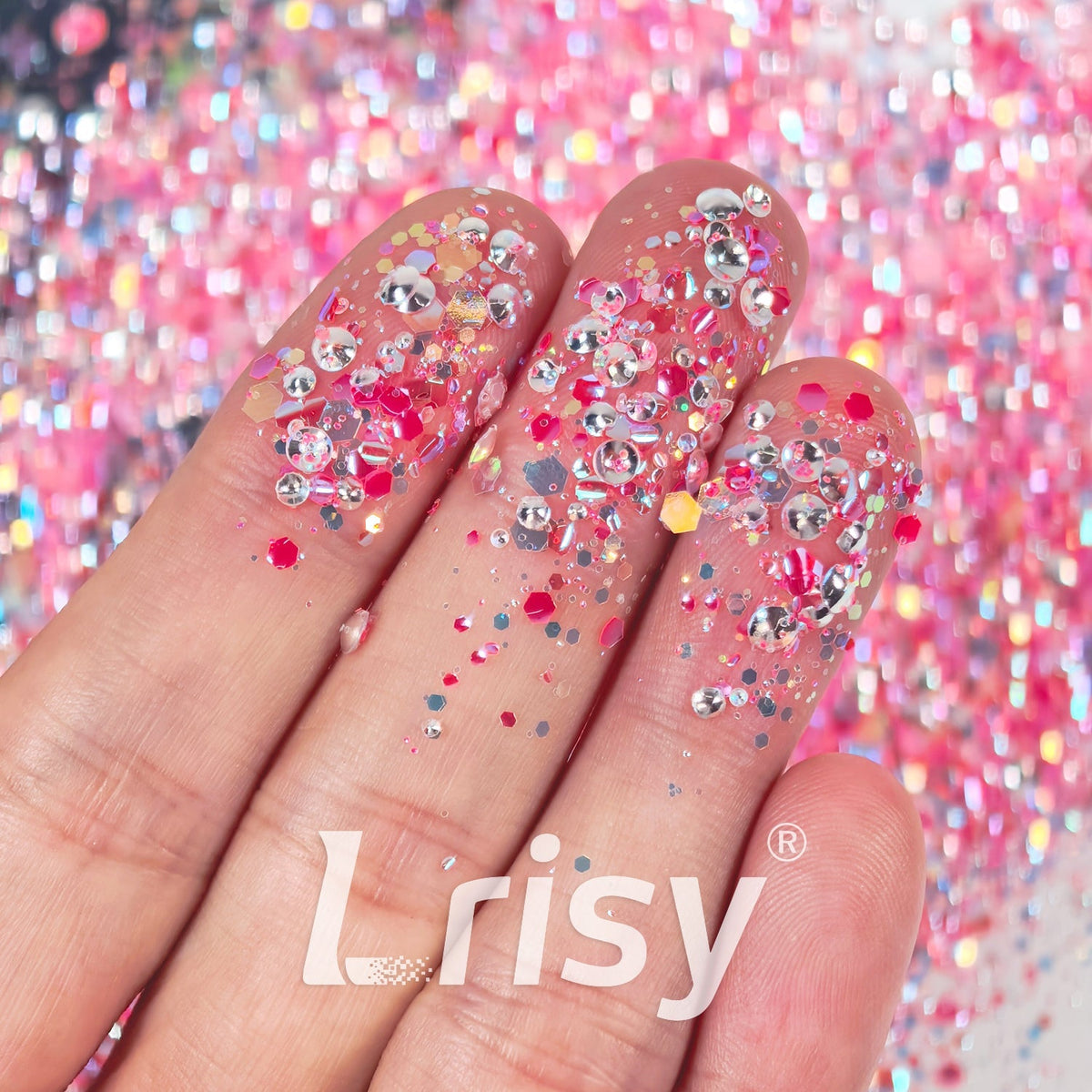
Quick Answer: Holographic glitter diffracts white light into a full rainbow through a micro-prismatic surface pattern, while iridescent glitter uses a thin-film coating that shifts between two complementary colors depending on the viewing angle. For nails, festivals, and "wow" statement pieces, holographic delivers the stronger effect and photographs better under almost any light - which is why it outsells iridescent roughly 3:1 in unit volume. For bridal, cosmetics, and luxury crafts, iridescent's subtle two-tone shift reads as "elegant" and commands 30-45% higher per-unit prices. For resellers, the winning inventory split is 60-70% holographic for volume and 30-40% iridescent for margin - and never drop iridescent entirely, because it is your upsell path.
Last year, two Etsy sellers listed glitter tumblers on the same day. Mia used holographic silver - every photo she posted captured a full rainbow arc across the cup, and her listing sold out in a week. Jordan used iridescent white-champagne. In her photos the tumbler looked almost plain - the shift only showed at specific angles. But the customers who did buy left five-star reviews calling it "elegant," "expensive," and "bridal." Jordan charged 40% more per tumbler and cleared the same profit.
Neither finish is objectively better. They are two different optical technologies that reward different applications and different sales channels. Choosing wrong means either a sparkle that photographs flat or an elegant shift that never gets the credit it deserves - and most buyers can't tell the difference until they've already paid.
This guide breaks down exactly how holographic and iridescent glitter are made, how they behave in different lighting, where each belongs, the real cost difference, and which one you should stock - whether you are a nail tech, a resin artist, or a reseller building inventory.
Key Takeaways
- Holographic glitter = rainbow diffraction. A micro-prismatic surface pattern splits white light into a full spectrum - red through violet - regardless of the base color.
- Iridescent glitter = two-color shift. A thin-film interference coating reflects one color straight-on and a different color at an angle (white?gold, pink?green, blue?purple).
- Holographic photographs better. It shows its effect under almost any light; iridescent needs direct light or the right angle to reveal its shift - which is why iridescent needs video or staged photography to sell.
- Holographic drives volume; iridescent earns margin. Roughly 3:1 unit volume for holo, 30-45% higher per-unit profit for iridescent in premium positioning.
- Manufacturing cost is nearly identical. Both start from the same PET film and differ only in the finishing layer - so the price difference you see is positioning, not production cost.
- For resale, weight inventory 60-70% holographic for general markets, but never drop iridescent - it protects your margin and opens the bridal and beauty channels.
Holographic vs Iridescent: The One-Sentence Difference Most Buyers Get Wrong
The fastest way to tell them apart: holographic is a full rainbow; iridescent is a two-color shift. Everything else - lighting behavior, price, durability, best use - follows from that single distinction.
Most buyers (and a surprising number of sellers) use the two words interchangeably, and the market rewards the confusion: both finishes have a prismatic, color-shifting look in marketing photos, and side-by-side they can be hard to tell apart in a single static shot. But hold a holo flake and an iridescent flake in your hand and the difference is immediate. Why this matters before you buy: you can't position, price, or photograph a finish you can't identify. If you order "holographic" and receive iridescent (or vice versa), the product you list will not match the effect your customers see - and that mismatch drives returns.
Why this matters for SEO and content: "what is holographic glitter," "holographic vs iridescent," and "color shift glitter" are separate queries with separate intents. A buyer searching "holographic vs iridescent" wants exactly this comparison before committing to a purchase - which is why this guide exists as a decision tool rather than a product pitch.
How Each Finish Is Made: Diffraction Grating vs Thin-Film Interference
The visual difference comes down to two entirely different optical mechanisms. Understanding them explains everything else - lighting behavior, price, durability, and best use.
Holographic glitter: micro-prismatic diffraction
Holographic glitter starts with a polyester film base. The manufacturer embosses a microscopic prism pattern onto the film surface, then applies color. That embossed pattern acts as a diffraction grating: when white light hits it, the pattern splits the light into its component wavelengths, producing the full rainbow - red, orange, yellow, green, blue, violet - regardless of the underlying pigment color.
Key properties:
- The rainbow comes from the surface pattern, not the dye - so any base color (silver, pink, gold, blue) can carry a holographic finish.
- Silver holographic is the most popular because the neutral base lets the rainbow dominate.
- The effect is visible under most lighting - even cloudy daylight.
You can see the effect range in LRISY's holographic glitter collection, which carries the neutral and tinted variants.
Iridescent glitter: thin-film interference
Iridescent glitter also uses a polyester base, but instead of a prism pattern it applies a thin-film interference coating. This coating reflects certain wavelengths of light while transmitting others, so the perceived color depends on the angle of viewing - a phenomenon described by thin-film interference physics. Look straight on and you see one color; tilt the surface and a second color appears.
Common iridescent pairings:
- White ? gold
- White ? blue
- Pink ? gold
- Pink ? green
- Blue ? purple
- Green ? gold
Key properties:
- The shift is subtle - two colors, not a full rainbow.
- In low or indirect light, iridescent can look like ordinary metallic glitter.
- Under direct light or at an angle, the second color emerges.
- That subtlety is both its elegance and its limitation.
LRISY's iridescent glitter range shows the full set of two-tone pairings used in cosmetics and bridal work.
| Property | Holographic | Iridescent |
|---|---|---|
| Optical mechanism | Prismatic diffraction grating | Thin-film interference coating |
| Visual effect | Full rainbow (7 colors) | Two-color shift |
| Lighting sensitivity | Visible under most light | Needs direct light or angle |
| Base material | PET film + embossed pattern | PET film + interference coating |
| Photography | Photographs well anywhere | Requires staged lighting |
| Perceived value | Fun, flashy, festival | Elegant, premium, bridal |
Why the mechanism matters for buyers: the mechanism decides the durability of the effect. A holographic rainbow is baked into the surface structure - it survives light, heat, and solvent exposure far better than a pigment that can dissolve. Iridescent's coating is an added layer, so its quality depends on coating thickness and adhesion - which is why cheap iridescent can wear away to a flat metallic look while premium iridescent holds its shift for years. When a finish "loses its magic," it's almost always the coating, not the color.
The Lighting Test: Why Holographic Photographs Itself and Iridescent Needs Staging
How each finish behaves under real-world lighting determines customer satisfaction, return rates, and resale success. This is the practical test that separates the two finishes - and the reason photography strategy should differ for each.
Direct sunlight
Both finishes shine. Holographic fires off visible rainbow arcs; iridescent reveals its full two-tone shift. In direct sunlight, the gap between them narrows - which is why most "side by side" comparison photos shoot in sunlight. Why this matters: if you're comparing the two in person, do it in sunlight - it's the only light where the difference is subtle. In every other condition, they separate clearly.
Indoor / ambient light
The finishes separate. Holographic still reads as rainbow sparkle under fluorescent and LED light. Iridescent can flatten to a plain metallic look, its shift invisible until the surface tilts. Why this matters for product design: if your product will be seen mostly indoors - wedding decor, home goods, everyday nails - test iridescent in your actual lighting before committing. A bridal centerpiece that reads as plain gold in the reception hall is a refund waiting to happen.
Low light / evening
Holographic retains noticeable color-shift; iridescent reads as simple silver or white sparkle. Why this matters: for evening wear, event decor, or night photos, holographic is the safer bet. The rainbow needs very little light to fire; the two-tone shift needs direct light to appear at all.
The reseller implication: iridescent products need marketing that shows the shift - short video clips, angled shots, or "see how it changes in light" captions. Holographic sells itself in a static photo. If you cannot produce good video, prefer holographic for retail listings - and if you insist on iridescent, budget for video.
Where Holographic Glitter Belongs: The Volume Plays
Holographic is the volume play. Its rainbow effect is immediately obvious, which makes it the default for anyone who wants "maximum sparkle" - and it photographs well enough to sell without explanation.
Nail art
Holographic nail polish and powder are perennial bestsellers. The effect photographs well for social media, which drives organic demand. Why it works: a rainbow arc reads as "expensive" on a nail in a way a flat shimmer can't - and it delivers in one coat what other finishes need layering to achieve. For nail applications, ensure the glitter is solvent-resistant so the rainbow doesn't bleed in the polish. LRISY's solvent-resistant glitter for nail polish includes holographic options that hold their color.
Festival and party
Body glitter, face glitter, and costume work all favor holographic - the more rainbow, the better under club and stage lights. Why it wins here: festival lighting is unpredictable and often low, and holographic is the only finish that keeps firing in those conditions.
Resin art
Holographic is a resin staple. A rainbow arc suspended in a geode or coaster reads as "expensive" to most buyers, and the effect is forgiving across resin brands. Why it works in resin: the prism pattern is structural, so it survives the exothermic heat and the clear epoxy actually amplifies the rainbow. Always use heat-resistant holographic glitter rated to at least 180�C; see the glitter for resin art guide for the full material checklist.
Kids' crafts and scrapbooking
Rainbow effects dominate children's craft content. Holographic is the default finish for card-making, stickers, and school projects. Why it wins here: the effect is self-explanatory - a child sees rainbow, a parent buys rainbow, no staging required.
Where Iridescent Glitter Belongs: The Margin Plays
Iridescent is the margin play. Its subtle two-tone shift reads as sophisticated, which lets you charge premium prices in categories where "elegant" beats "flashy."
Bridal and weddings
Champagne-white, rose-gold-white, and pearl iridescent finishes dominate bridal content. The shift is subtle enough to feel tasteful on invitations, centerpieces, and favors. Why brides pay a premium for it: restraint reads as expensive - the same reason a simple gold band costs more than a flashy rhinestone ring. This is where iridescent's higher margins live.
Cosmetics and skincare
Highlighters, lip glosses, and body shimmer use iridescent finishes because the effect reads as glow rather than glitter. Why it works: a subtle two-tone shift on skin reads as a natural sheen, not a sparkle - which is what cosmetic buyers pay for. Cosmetic-grade iridescent products command the highest price per gram in the entire glitter market. Check the cosmetic glitter regulations guide for the FDA vs REACH compliance you need before selling.
Luxury crafts and home decor
Resin coasters, candle jars, and decorative accents with a white-to-gold iridescent shift read as "artisan" rather than "craft." Why it works: the same product in holographic reads as "fun"; in iridescent it reads as "designed." Different buyers, different willingness to pay - and the artisan buyer is the one who leaves a higher average order value.
Real-world example: an acrylic tumbler reseller tested both finishes at the same price. Holographic tumblers sold 3.2x more units. Iridescent tumblers, relabeled as "bridal shimmer" and priced 35% higher, outsold holographic by profit margin. Her revenue from both lines was nearly identical - one on volume, one on margin. That's the entire business case in one story.
Cost Comparison: Is One Finish Actually Cheaper to Make?
Production cost is nearly identical. Both holographic and iridescent start from the same PET film and differ only in the finishing layer - an embossed prism pattern versus an interference coating. The wholesale price differences you see in the market are almost always marketing and brand positioning, not raw cost.
| Factor | Holographic | Iridescent |
|---|---|---|
| Raw material | PET film | PET film |
| Finishing layer | Embossed micro-prisms | Thin-film interference coating |
| Base cost | Comparable | Comparable |
| Market price | Volume-driven, lower per unit | Premium-positioned, higher per unit |
| Color range | Broader (any base + rainbow) | Narrower (fixed two-tone pairs) |
| Durability of effect | Structural - survives heat & solvent | Coating-dependent - buy quality |
Why the cost story matters for pricing: because the raw-cost gap is small, the decision is strategic, not financial. If a supplier charges a large premium for "holographic" or "iridescent" without a spec sheet, the premium is marketing, not material - and you should compare suppliers on quality documentation, not sticker price. The bulk glitter pricing guide walks through the unit-cost and MOQ math for both finishes.
Which Sells Better in 2026? The Volume vs Margin Math
Sales data across craft, festival, and nail markets consistently shows holographic outselling iridescent by roughly 3:1 in unit volume. But the margin story reverses it. Iridescent products, positioned as premium, routinely earn 30-45% higher per-unit profit. Two revenue pools, two different winners - the same pattern you see in the rose-gold-versus-yellow-gold comparison, and for the same reason: the flashy finish wins volume, the subtle finish wins margin.
The data-driven inventory rule
- Weight inventory 60-70% holographic for general craft, festival, and nail markets.
- Keep a 30-40% iridescent position for bridal, cosmetic, and luxury lines.
- Never drop iridescent entirely. It is your margin insurance and your upsell path.
- Match the finish to the channel: Amazon and big-box favor holographic; Etsy bridal sections reward iridescent.
Why the mix beats a single finish: a store stocked only in holographic wins volume but leaves margin on the table in every bridal or beauty order. A store stocked only in iridescent earns great margins but loses the seasonal bulk orders that keep cash flowing. The 60/40 split captures both pools - which is why resellers who scale fastest run a mix rather than betting on one finish.
For a deeper look at inventory strategy, supplier vetting, and bulk pricing, the complete wholesale glitter buying guide covers the financial side of stocking both finishes.
The Material Rules Both Finishes Share (Safety, Heat, Solvent Resistance)
Despite the different optics, both finishes share the same material requirements - and skipping any of them produces the same failures: bleeding, melting, and returns.
- Cosmetic-grade for skin and eyes. Only cosmetic-grade, FDA-compliant glitter belongs near the face - craft-grade holographic and iridescent have sharp die-cut edges that scratch the cornea and skin.
- Solvent-resistant for polish. Solvent resistance stops the finish coating from dissolving and bleeding in nail polish - a dissolved holographic rainbow turns to grey, and a dissolved iridescent shift turns to plain metallic.
- Heat-rated for resin. 180�C+ to survive the exothermic curing heat. Thick pours can reach 150-200�C internally, which melts non-rated coatings.
- Consistent particle size. Predictable effect across every batch - ask for the spec sheet and size tolerances.
Why the material rules are identical: the difference between holo and iridescent is the finishing layer, but the durability is determined by the base film, coating quality, and safety certifications - the shared construction. That means you can evaluate both with the same checklist and buy both from the same vetted supplier with the same confidence.
Popular Holographic and Iridescent Products to Know
To see the difference in real product form, look at two representative finishes:
- Pastel holographic white: a soft white base carrying a rainbow diffraction - LRISY's pastel holographic white glitter is a good example of the "soft holographic" look that bridges festival and wedding aesthetics.
- Translucent iridescent pink: a color-shifting pink-to-green effect - the translucent iridescent pink 3D feather glitter shows how iridescent translates into dimensional, watercolor-like effects for resin.
Why product examples matter for buying: "holographic" and "iridescent" are category words - the actual effect varies by base color, particle size, and finish quality. Looking at real products lets you see the range within each finish before you write a spec or place an order. If you're building a product line, order a glitter sample set and test both finishes in your actual medium - resin, polish, or adhesive - before you commit to bulk.
FAQ: Holographic vs Iridescent Glitter
What is the difference between holographic and iridescent glitter?
Holographic glitter uses a micro-prismatic surface that diffracts white light into a full rainbow. Iridescent glitter uses a thin-film coating that shifts between two colors - one straight-on, another at an angle.
Is holographic or iridescent glitter better for nail polish?
Holographic delivers the stronger, more photogenic effect and is the bigger volume seller. Use solvent-resistant glitter so the finish doesn't bleed in polish. Iridescent works for subtle, elegant manicures.
Can you use holographic glitter in resin?
Yes, if it is heat-resistant to at least 180�C. Holographic is a resin staple because the rainbow effect reads as premium. Mix glitter in after combining the resin parts.
Which glitter sells better for resale?
Holographic outsells iridescent roughly 3:1 in volume. But iridescent earns 30-45% higher per-unit margin in bridal, cosmetic, and luxury positioning. Stock both.
Is iridescent glitter the same as holo glitter?
No. Holo = full rainbow diffraction from a prism pattern. Iridescent = a two-color shift from a thin-film coating. They look similar in marketing photos and very different in person.
Which finish photographs better?
Holographic photographs well under any light. Iridescent requires direct light or angled shots to reveal its shift - it needs video or staged photography to sell effectively online.
Is holographic glitter safe for skin and eyes?
Only cosmetic-grade, FDA-compliant holographic glitter is safe for skin and eyes. Craft-grade holographic has sharp edges that scratch. Always check the label for cosmetic-grade or external-use compliance.
Where can I buy both finishes wholesale?
Buy from a factory-direct manufacturer that publishes finish specs and test documentation. LRISY stocks dedicated holographic glitter and iridescent glitter collections at wholesale pricing, with sample sets available first.
?? Reading Next
Continue exploring the LRISY glitter library:
- Glitter for Resin Art - the bulk buying guide for crafters and small businesses.
- Bulk Glitter Pricing Guide - unit costs, MOQs, and hidden fees.
- Cosmetic Glitter Regulations - FDA vs REACH compliance for glitter products.
- Bulk Glitter Buying Guide - sizes, finishes, and MOQ math at wholesale scale.
- How to Vet a Wholesale Glitter Supplier - the certification and QA checklist.
Conclusion
Holographic and iridescent glitter are two different optical technologies serving two different buyers. Holographic's rainbow diffraction drives volume across nails, festivals, and general crafts - it photographs itself and sells on sight. Iridescent's subtle two-tone shift earns premium margins in bridal, cosmetic, and luxury lines - it needs the right positioning and lighting to shine. Match the finish to the market, stock both, and let each do the job it's best at.
Why it matters: the holographic and iridescent finishes together anchor the color-shift segment of the glitter market - the fastest-growing finish category of the last five years. The sellers who win in 2026 aren't the ones who guess which finish is "better." They're the ones who understand the volume-versus-margin split, buy both from a vetted supplier, and position each finish for the channel that rewards it.
Ready to compare them in person? Browse LRISY's holographic glitter and iridescent glitter collections, or start with the full glitter powder range to find both finishes in one place. Order a glitter sample set and test the effect in your own product before you scale up.

Leave a comment
All comments are moderated before being published.
This site is protected by hCaptcha and the hCaptcha Privacy Policy and Terms of Service apply.