
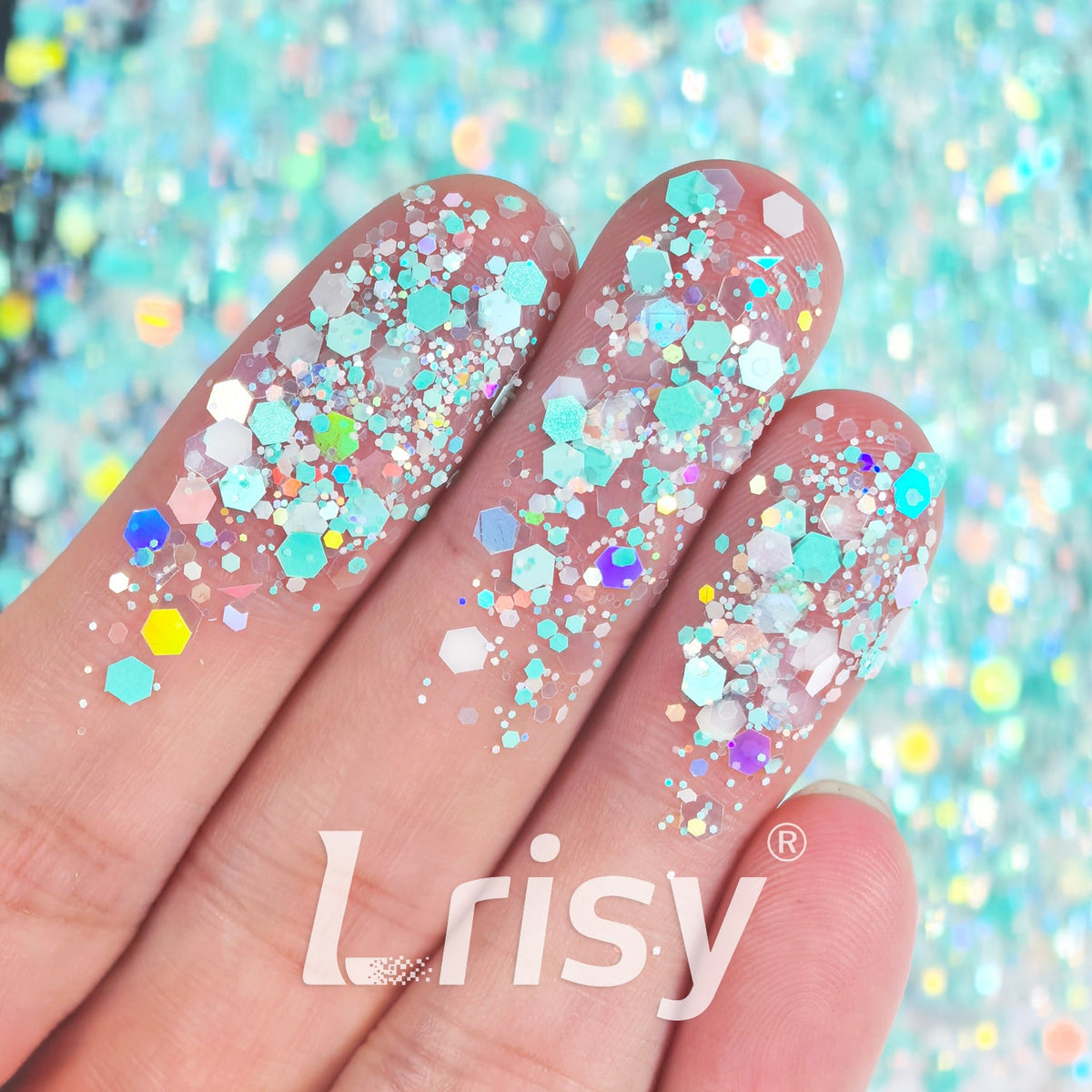
Quick Answer: Glitter is not a single substance, so "is it toxic" has no one answer. Cosmetic-grade glitter is pigment-colored plastic that is non-toxic even in small ingested amounts. Craft glitter is frequently metal-based, which heats up fast under a nail file and can trigger skin reactions. The difference matters most wherever glitter touches skin, eyes, lips, or nails.
The pattern shows up in nail forums constantly: a tech posts a set she is proud of, and the comments fill up with warnings before the likes do. Not about her technique — about the glitter. The jar cost four dollars at a craft store, the color is perfect, and nobody mentioned that the contents might be metal.
That gap between "it's just glitter" and "wait, what is it actually made of" is the whole problem. The word covers materials with almost nothing in common: precision-cut plastic film, aluminum foil, mica flakes, and coated metal powders all get called glitter. Some are built for contact with skin. Some are built for greeting cards.
So this is not going to be a yes-or-no article. Instead, you get the three things that actually determine whether a given glitter is safe for a given job:
- 1. What it is made of — plastic, metal, or mineral, and how that behaves under heat and friction
- 2. Which grade it is — craft or cosmetic, and the concrete differences between them
- 3. Where it is going — eyes, lips, skin, nails, or a resin coaster nobody will touch
By the end you will be able to look at any jar or listing and judge it yourself, without guessing from the price or the label design.
If you work with glitter professionally, the material question stops being theoretical the first time a client has a reaction. Let's start with what is actually inside the jar.
Key Takeaways
- Cosmetic-grade glitter is pigment-colored plastic; craft glitter is frequently metal-based. That material difference, not the word "glitter," determines how the product behaves under heat and on skin.
- Particle shape is a skin-contact issue. Cosmetic-grade particles are typically rounded; craft glitter is commonly hexagonal, which means sharp edges against cuticles and lash lines.
- Metal-based glitter conducts heat when filed or buffed — a mechanical problem that shows up as irritation before any chemical question arises.
- The EU has already restricted loose craft glitter under Regulation (EU) 2023/2055, with cosmetic categories phased in through 2035. Biodegradable, soluble, natural and inorganic glitter are exempt.
- Documentation is the practical test. An MSDS and an explicit grade claim tell you more than any adjective on the label; where neither exists, that absence is the answer.
- Craft grade is not automatically dangerous — it is simply built for applications with no body contact. The grade question only becomes critical when skin, eyes, lips or nails are involved.
Why "Is Glitter Toxic?" Has No Single Answer
Asking whether glitter is toxic is a bit like asking whether plastic is toxic. Both words describe a category, not a chemical. The category contains materials that behave nothing alike — some stay inert under heat, some conduct it, some are mined from the ground and have been used for thousands of years.
Most glitter on the market today falls into three material families, and the safety profile of each one is different.
Copolymer plastics (PET). This is the thin, precision-cut film behind most cosmetic-grade glitter. It is color-stable, resists solvents, and does not conduct heat. When a supplier says their glitter is PET, they are telling you it is a plastic film — which is why it can be color-matched batch after batch, and why it does not scorch when a nail file passes over it.
Metal foil and coated metal powders. Cheaper craft glitter often starts as aluminum foil or metalized film. It is bright and inexpensive, and it conducts heat — a detail that matters a great deal the moment friction enters the picture. This is the material behind most of the warnings you see in professional nail communities.
Mica and other minerals. Mica is a naturally occurring mineral that has been used as a decorative shimmer for at least two thousand years; some of the world's oldest cave paintings contain mica flakes. Modern mineral-based shimmer is mined, milled, and often coated, and its behavior depends on what it has been coated with.
There is also a fourth variable that cuts across all three: how the material is colored. Pigments and dyes behave differently in contact with skin, solvents, and adhesives — a point we will come back to, because it is one of the clearest ways to tell a cosmetic-grade product from a craft one.
The practical takeaway: "glitter" tells you almost nothing. The material name — PET, metal, mica — tells you what you actually need to know.
For a deeper breakdown of how these materials are manufactured and cut, see our guide to what glitter is made of.
Why Craft Glitter Can Irritate Skin — and What Cosmetic Grade Does Differently
"Craft glitter" and "cosmetic grade glitter" are not marketing tiers of the same product. They are different specifications built for different jobs, and the gap shows up in six places.
| What to compare | Craft glitter | Cosmetic grade glitter |
|---|---|---|
| Base material | Frequently metal or metalized film | Specific plastics, commonly PET film |
| Behavior under friction | Conducts heat quickly when filed or buffed | Does not conduct heat the same way |
| Coloring method | Often dye-based | Pigment-based |
| Particle shape | Commonly hexagonal cuts | Commonly rounded particles |
| Documentation | Usually none supplied | MSDS available on request |
| Packing standard | No cosmetic packing requirement | Packed under good manufacturing practice |
The friction row is the one that catches people out. A nail professional writing for Scratch Magazine put it plainly: cosmetic-grade glitter "won't heat up when filing off because it's made of plastic where craft shop glitter is usually made of metal which will heat up very quickly when filing and can cause skin reactions and irritation." That is a mechanical problem before it is a chemical one — heat plus skin equals irritation, regardless of what else is in the jar.
The mechanism explains why the grade matters even when the glitter never touches bare skin directly. Filing generates friction, friction generates heat, and metal conducts that heat into whatever it sits against — in a gel or acrylic service, that means the nail bed and the surrounding skin. A client who reports irritation afterwards has not reacted to a mysterious chemical; she has a small thermal burn. Plastic-based cosmetic glitter does not conduct heat the same way, which is why professional guidance treats the material choice as a safety decision rather than a cosmetic preference.
Coloring matters more than most buyers realize. Pigment-based color sits in the material rather than on it. Dye-based color is far more likely to migrate when it meets a solvent — which is exactly what happens when glitter goes into gel polish or acrylic monomer. If you have ever seen a glitter bleed color into surrounding product, you have seen a dye-based material at work.
Shape is a skin-contact issue. Rounded particles have no sharp corners to catch or abrade. Hexagonal cuts do. On a greeting card that difference is invisible. On a client's cuticle it is not.
Documentation is the practical test. Cosmetic-grade glitter comes with a material safety data sheet so you know what is in the product and whether it meets the standard — the same point industry educators make when they warn against substituting craft glitter in professional services. Craft glitter usually does not, and that absence is meaningful: an unknown material reacting with an unknown adhesive is a problem with no upside. There is also an insurance dimension — as the same industry guidance notes, a professional who uses non-cosmetic-grade glitter and has an incident may find the work is not covered. The MSDS is not a formality you file away. It is the document that tells you the base material, the colouring method, and whether the product was built for the use you have in mind.
One clarification worth making, because the distinction gets overstated: craft grade is not automatically dangerous, and cosmetic grade is not automatically necessary. A resin coaster that will sit on a shelf has no skin-contact requirement at all, and craft glitter is perfectly reasonable there. The grade question only becomes critical when the answer to "will this touch a person?" is yes.
Where skin, eyes, lips, or nails are involved, the specification is not a preference — it is the product category. Browse cosmetic grade glitter if that is the use case you are buying for.
Safety by Body Area: Eyes, Lips, Skin, Nails
"How safe is glitter" becomes a much easier question once you specify where it is going. The requirements are genuinely different for each area, and treating them as one problem is how mistakes happen.
Eyes
The eye area is the least forgiving. The American Academy of Ophthalmology advises keeping cosmetic particles out of the eye itself and being careful with anything that can flake or shed near the lash line — their guidance on eye makeup is worth reading in full if you work with clients.
Practically, that means cosmetic-grade only, applied away from the immediate lash root — and never craft glitter. A flake that reaches the eye is a medical situation, not a styling one.
If you are buying for eye-area use, look specifically for products labeled for cosmetic use. "Body safe" and "eye safe" are not interchangeable claims.
Lips
Lip products are swallowed in small amounts over the course of wear, which is why the standard here is closer to a food-contact standard than a skin-contact one. Lip-safe glitter should be cosmetic grade and explicitly labeled for lip use. Browse cosmetic glitter for lip gloss if that is your project.
Skin and body
Body glitter sits under a combination of sweat and friction, plus the sunscreen most people forget they are wearing — all three accelerate breakdown and migration. The relevant label is body safe, and it should appear on the product itself, not just in a category description. Fine particle sizes generally sit better on skin than chunky cuts, which catch on fabric and transfer.
Nails
Nails are where this conversation actually happens in practice, and where the craft-versus-cosmetic question comes up most often. The common assumption is that because glitter is sandwiched between layers of gel or acrylic, it never touches skin. That assumption does not survive contact with a real service. The same industry guidance cited earlier puts it directly: "It's highly unlikely that you'll be able to guarantee 100% that the product won't come into contact with the skin of yourself or the client during the service at any point."
Solvent resistance is the second nail-specific requirement. Gel polish and acrylic monomer will attack a dye-based color, and the result is bleeding into surrounding product. Solvent-resistant glitter is formulated for exactly this environment.
| Where it goes | Minimum specification | The detail people miss |
|---|---|---|
| Eyes | Cosmetic grade, eye-area labeled | Keep particles off the lash root; craft glitter is never acceptable here |
| Lips | Cosmetic grade, lip-use labeled | Small amounts are ingested during wear, so the standard sits closer to food contact |
| Skin and body | Explicit "body safe" label | Sweat, friction and sunscreen accelerate migration; fine cuts sit better than chunky |
| Nails | Cosmetic grade + solvent resistant | Zero skin contact cannot be guaranteed during application |
| Craft objects, no body contact | Craft grade is reasonable | No skin-contact requirement exists, so the grade question does not apply |
What About Ingestion?
This is the question behind most of the search volume, and it deserves a straight answer rather than a disclaimer.
The short version: it depends entirely on the material, and the two grades behave differently.
Cosmetic-grade glitter is, by specification, made from plastic rather than metal, and it is colored with pigment rather than dye. The industry description of this material is that it is non-toxic even if ingested in small quantities — which is why it is permitted in lip products at all. That is not the same as saying it is edible, and it is certainly not a reason to treat it as a food ingredient. It means that the small incidental amounts involved in lip wear are within the material's designed use.
Craft glitter is a different situation. Because the base material is frequently metal or metalized film, and because the coloring may be dye-based, the same "small amount" reasoning does not transfer. This is one of the clearest practical reasons the two grades should never be substituted for each other around the mouth.
A few things worth being precise about:
- Neither grade is food. Cosmetic-grade glitter is manufactured to a cosmetic standard, not a food standard. "Non-toxic in small ingested amounts" is the correct description; "edible" is not.
- If glitter has been swallowed in more than an incidental amount, that is a medical question, not a shopping question. Contact a poison control center or a medical professional rather than consulting a product page.
- Children's craft projects deserve extra care. Craft glitter is a common craft material and its use with children is normal, but it should not be treated as safe to put in the mouth.
The pattern that runs through this entire article applies here too: the label tells you which material you are holding. A product described as cosmetic grade and pigment-colored was built for proximity to the mouth. A jar of craft glitter was not.
If your project involves lip products, start from cosmetic grade glitter rather than adapting a craft material.
Why the EU Is Restricting Glitter (And What Compliant Options Look Like)
There is a second meaning of "toxic" that has nothing to do with the person using the glitter, and it is now the single biggest regulatory force acting on this market.
Most conventional glitter is a synthetic polymer microparticle. That classification puts it inside the European Union's microplastics restriction, Commission Regulation (EU) 2023/2055, which entered into force on 17 October 2023. The regulation restricts intentionally added synthetic polymer microparticles — a category that includes glitter — in order to reduce environmental release.
The implementation is staggered rather than immediate, and the timetable matters if you sell into or ship to Europe:
| Product category | Restriction applies from |
|---|---|
| Loose glitter sold as a craft material | Already restricted |
| Rinse-off cosmetics | 16 October 2027 |
| Leave-on cosmetics | 16 October 2029 |
| Make-up, lip and nail cosmetics | 16 October 2035 (labeling required from 17 October 2031) |
Not everything is caught by this. The restriction exempts glitter that is biodegradable, soluble, natural, or inorganic. That carve-out is why biodegradable glitter has moved from a niche product to a compliance strategy in a relatively short time.
Enforcement is real, not theoretical. Belgian health authorities have run public campaigns after microplastic glitter continued to circulate following the ban — a sign that the transitional periods are being treated as deadlines rather than suggestions.
The technical response is already in development. Research teams have produced biodegradable glitter derived from plant cellulose, and biodegradable options are now specified for applications as varied as fabric printing and packaging. Whether those materials match conventional glitter on every performance dimension is still being worked out — biodegradability is a different property from heat resistance or solvent resistance, and a product can be strong on one and weak on the other.
What this means practically, depending on who you are:
- If you sell finished products into the EU, the category your product falls into determines your deadline, and the deadlines are years rather than months — but they are fixed.
- If you buy glitter for your own workshop, biodegradable options remove the regulatory question entirely for craft applications.
- If you are formulating for cosmetic use, the combined pressure means specifying a compliant material early is cheaper than reformulating later.
For projects where environmental compliance is a factor, biodegradable glitter meets the exemption criteria rather than relying on a transitional period.
How to Verify Safety Before You Buy
Everything above reduces to three checks you can run on any listing or jar before money changes hands.
1. Look for the MSDS.
A material safety data sheet tells you what is actually in the product. Cosmetic-grade suppliers provide one; the absence of one is itself information, because it means nobody has documented the composition. If a listing cannot tell you the base material and the coloring method, treat that as an unanswered question rather than a neutral fact.
2. Look for an explicit grade claim.
"Premium quality" and "professional grade" are marketing language. "Cosmetic grade," "body safe," and "eye safe" are claims with defined meanings, and they should be specific rather than implied. If the listing describes a product as suitable for skin, it should say so in those terms — and if it only says "safe," ask safe for what.
3. Match the material to the job.
This is the one buyers skip, and it is the one that prevents most problems. A resin coaster, a greeting card, and a festival makeup look have three different requirements. Buying cosmetic grade for a project that never touches a person is not wasteful, but buying craft grade for one that does is a false economy.
Where a supplier's own documentation fits
A supplier who works with cosmetic manufacturers will normally hold certification documentation for the materials they sell. On that basis you can reasonably expect to see MSDS files available, an FDA-certified cosmetic-grade range, and a clear separation between that range and general craft stock.
One important nuance, and it is worth stating plainly rather than glossing over: non-cosmetic-grade glitter is not automatically unsafe. The distinction between grades is about specification and intended use, not about a line between "dangerous" and "safe." A material without cosmetic certification can still be entirely appropriate for applications with no skin contact. What the grade tells you is how much is documented and what standard it was built to — which is exactly what you need to know when skin contact is part of the plan.
If you are buying at volume and need material documentation for your own compliance records, our wholesale sourcing page covers how that works.
Frequently Asked Questions
Is glitter toxic to humans?
Not as a category — "glitter" covers several different materials. Cosmetic-grade glitter is pigment-colored plastic that's non-toxic even in small ingested amounts. Craft glitter is often metal-based, which conducts heat under filing and can cause skin irritation. The material and the intended contact area determine the answer.
What is the difference between craft glitter and cosmetic grade glitter?
Cosmetic-grade glitter is made from specific plastics, colored with pigment, cut into rounded particles, supplied with an MSDS, and packed under cosmetic manufacturing standards. Craft glitter is frequently metal-based, often dye-colored, commonly hexagonal, and usually sold without documentation. The grades are built for different jobs.
Is glitter safe for eyes?
Only cosmetic-grade glitter should be used anywhere near the eye area. The American Academy of Ophthalmology advises keeping cosmetic particles out of the eye itself and being careful with anything that may flake near the lash line. Craft glitter should never be used on or around the eyes.
Can I use craft glitter on my nails?
The professional guidance is not to. Even when glitter is sandwiched between gel or acrylic layers, no service can guarantee zero skin contact, and metal-based craft glitter heats up during filing. Industry guidance also notes that insurance may not cover incidents involving non-cosmetic-grade materials.
Is glitter safe if swallowed?
Cosmetic-grade glitter is described as non-toxic in small ingested quantities, which is why it's permitted in lip products. It isn't a food and should not be treated as edible. Craft glitter, being often metal-based, doesn't carry the same reasoning. If more than an incidental amount has been swallowed, contact a medical professional or poison control.
Is biodegradable glitter actually safe?
Biodegradable glitter meets the EU's exemption criteria for the microplastics restriction, which is its main regulatory advantage. That addresses the environmental question, not the skin-contact question. For body or cosmetic use, you still need a cosmetic-grade product — biodegradability and cosmetic certification are separate properties.
Is rhinestone glue safe for skin?
It depends on the adhesive. Cosmetic and body-safe adhesives are formulated for skin contact and are the right choice for wearable projects. Industrial adhesives, including some high-strength craft glues, are not formulated for skin and should not be used where they will sit against skin. Check the product's own safety documentation rather than assuming from the category.
What to Do Before Your Next Glitter Purchase
Glitter is not toxic or non-toxic as a category — it's a group of materials with very different specifications, and the match between material and use is what determines whether a project is safe.
Three habits cover almost every situation:
Check the material, not the price. PET film, metal foil, and mica each behave differently when heat, solvents or skin contact enters the picture. A cheap jar and an expensive jar can be the same material, or completely different ones.
Match the grade to the contact area. Craft grade is reasonable for anything that won't touch a person. For eyes, lips, skin, or nails, specify cosmetic grade — and for lips, confirm the product is labeled for lip use specifically.
Use documentation as your tiebreaker. An MSDS and an explicit grade claim tell you more than any adjective on the front of the jar. If neither exists, that's your answer.
If you want to verify material specifications before committing to a production run, 10g sample packs let you test the actual material — particle size, solvent behavior, color stability — before placing a bulk order.
---
Reading Next
Keep exploring glitter safety and sourcing:
- What Is Glitter Made Of? — The base materials behind every glitter type, from PET film to mica.
- The Best Glue for Rhinestones: An Adhesive Compatibility Guide for Eve — Related reading for buyers working with the same materials.
- Best Glitter Nail Polish 2026 Guide, Complete Brand Buying Guide — Related reading for buyers working with the same materials.
- Cosmetic Grade Glitter — The FDA-certified range, with MSDS available on request.

Leave a comment
All comments are moderated before being published.
This site is protected by hCaptcha and the hCaptcha Privacy Policy and Terms of Service apply.