
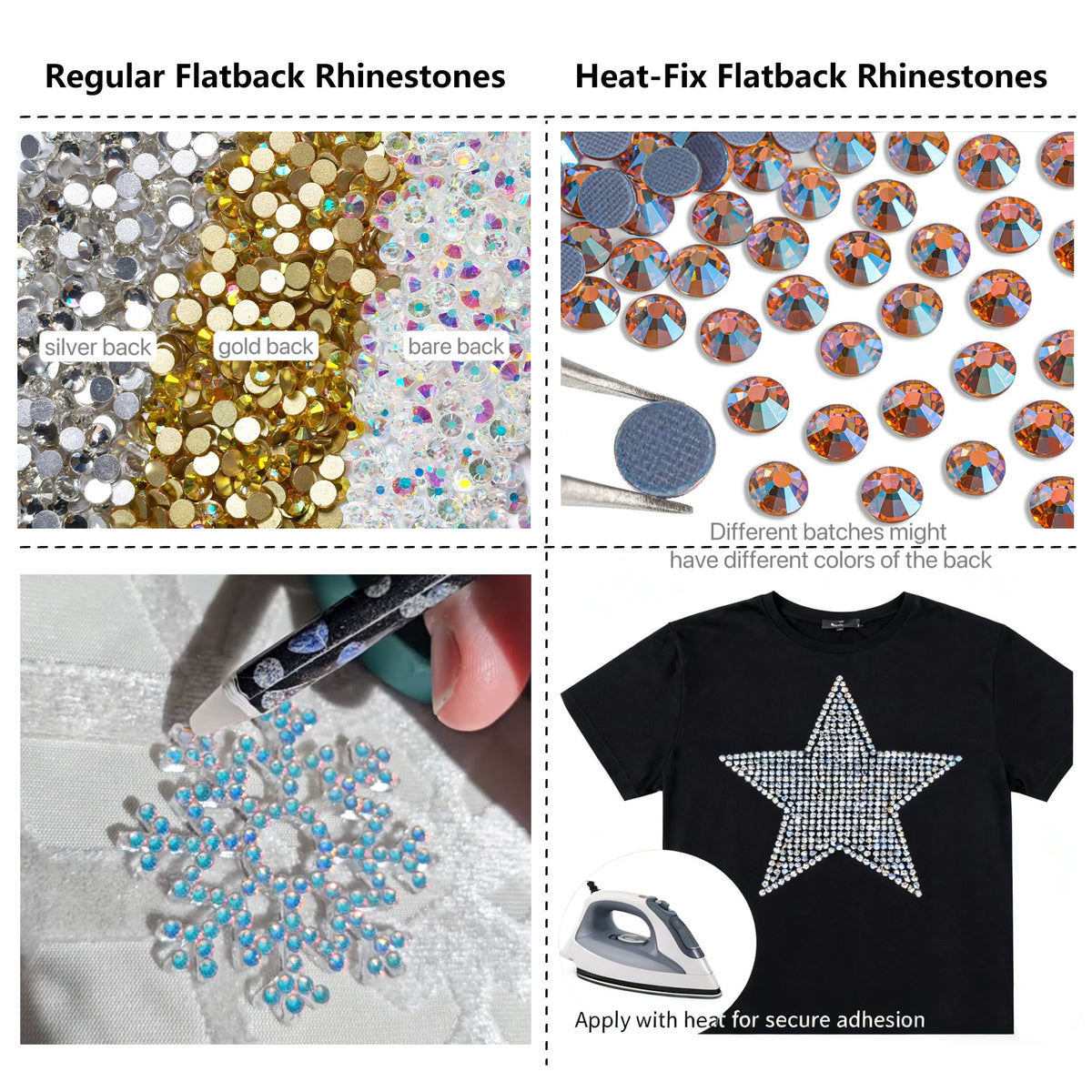
If you are comparing Diamond Cut vs Korean 5A rhinestones, here is what you need to know: Diamond Cut refers to a machine-cut manufacturing process that creates sharp, precision facets on the stone surface for maximum sparkle. Korean 5A is a quality grading tier that certifies dimensional consistency, coating uniformity, and low lead content. They are not competing standards; they describe different attributes, and the best rhinestones combine both. This guide breaks down exactly what each term means, how to verify claims, and when paying for the premium combination actually matters for your project. For a broader overview of how rhinestones are categorized, the rhinestone manufacturing entry on Wikipedia provides useful historical context on cut methods and materials.
Open a shipment of 3,000 "Diamond Cut Crystal AB" rhinestones for a custom bridal gown and the work lights tell the story fast. The stones look dull, the facet edges rounded, the AB coating full of visible bubbles. Sorting the batch eats 40 hours and rejects 800 stones; delivery runs two days late, and the order ends up costing $1,500 in restocking fees plus 40 hours of labor. The supplier had used "Diamond Cut" as a marketing label on molded stones.
That experience is not unusual. The rhinestone industry has a terminology problem: suppliers mix up cut methods, grade standards, and coating quality under vague umbrella terms. If you buy rhinestones in volume, you have probably paid for "Diamond Cut" stones that were never machine cut, or for "5A quality" that was actually downgraded stock. This guide gives you the vocabulary and inspection methods to know exactly what you are buying.
Here is what we will cover: what Diamond Cut actually means at the factory level, how the Korean 5A grading system works, a head-to-head comparison matrix, how to verify both claims without expensive equipment, price benchmarks by grade and cut type, and a decision framework for when each quality tier makes financial sense.
Key Takeaways
- Diamond Cut is a manufacturing process, not a quality grade. It means each facet is individually machine-cut after molding, creating sharp edges that maximize light refraction. Molded stones have rounded facet edges and less sparkle.
- Korean 5A is a batch-level quality certification. It checks dimensional tolerance (under 0.1 mm deviation), coating uniformity, facet alignment, and zero visible defects under 2x magnification. It does not guarantee machine-cut facets.
- The premium combination is Korean 5A + Diamond Cut + Low Lead. A stone with all three attributes delivers the best sparkle, consistency, and regulatory compliance, at a price of $0.025 to $0.045 per stone.
- You can verify Diamond Cut claims at home. A desk lamp and 2x magnification are enough to distinguish machine-cut from molded stones by examining facet edge sharpness and flash behavior under direct light.
- Bridal, luxury apparel, and stage costumes justify the premium. Craft projects, children's costumes, and home decor rarely need Diamond Cut Korean 5A quality — standard molded 5A stones are sufficient and save 40-60%.
Worried You Are Overpaying for Rhinestones? Here Is How to Tell
The most common reason buyers overpay is terminology confusion. A listing that says "Premium 5A Quality Rhinestones" sounds equivalent to "Diamond Cut Rhinestones" to an untrained eye. They are not. One describes a grade certification; the other describes a cut method. If you are paying a premium for "Diamond Cut" but receiving molded stones, you are overpaying by 60-100% per stone.
Price is where the confusion gets expensive. The price difference between standard molded stones and true Diamond Cut stones within the same grade is roughly 60-100%. For a bridal order of 5,000 stones, that is the difference between $60 and $120 for molded 5A versus $125 to $225 for Diamond Cut 5A. If you are paying the higher price but getting the lower quality, the financial impact scales with every order.
Look for these red flags in supplier listings. If the description does not explicitly say "machine cut" or "precision cut" or "Diamond Cut" in the technical specifications, it is almost certainly a molded stone. If the price is below $0.020 per stone for a stone described as Diamond Cut, the claim is likely false — genuine Diamond Cut Korean 5A stones rarely fall below $0.025 per stone even at wholesale volume. Request a pre-production sample batch of 50 stones and inspect them under 2x magnification before placing any large order.
For a deeper look at how to evaluate suppliers, read our complete guide to choosing a wholesale rhinestone supplier.
What Diamond Cut Actually Does to a Rhinestone (And Why It Matters for Sparkle)
When you hear "Diamond Cut" in the rhinestone industry, it refers to a specific secondary manufacturing process. Standard rhinestones are cast in a mold: the facet pattern is part of the mold cavity, and the stones come out of that mold with the facets already formed. The problem is that molded facets have slightly rounded edges where the molten glass settled against the mold seam. These rounded edges scatter light instead of reflecting it at precise angles.
True Diamond Cut rhinestones start as a molded blank, just like standard stones. But then a precision machine with diamond-tipped cutting heads cuts each facet individually. This secondary cutting process creates sharp, crisp facet edges at exact mathematical angles. Light enters the stone, bounces between these precisely cut facets, and reflects back to the viewer in concentrated flashes.
Why the cut method matters more than most buyers realize: The refractive behavior of a rhinestone is determined by the angle and sharpness of its facets. A 0.1 mm rounding at a facet edge changes the angle of reflection by several degrees. When that happens across 16 or 32 facets, the cumulative light loss is significant. A Diamond Cut stone can reflect 85-95% of incident light back toward the viewer. A molded stone with equivalent glass quality typically reflects 50-65%. The difference is visible under any direct light source. The Gemological Institute of America describes this facet-dependent light behavior as a key factor in gemstone brilliance.
Rhinestones described as "machine cut" or "precision cut" are synonymous with Diamond Cut. Some suppliers avoid the word "Diamond" for trademark or regulatory reasons and use "machine cut" instead. If you see either term in the technical specifications, the stone has undergone secondary machine cutting.
Our wholesale bulk rhinestones collection includes both molded and Diamond Cut options, with clear labeling so you always know what you are getting.
How the Cutting Process Affects Different Stone Sizes
The impact of Diamond Cut varies by stone size. On small stones (SS3 to SS12, roughly 1.5 mm to 3.5 mm), the difference between molded and machine-cut facets is subtle because the facets themselves are tiny. You need magnification to see the edge sharpness. On medium stones (SS16 to SS20, roughly 4 mm to 4.5 mm), the Diamond Cut advantage becomes visible to the naked eye under direct light. On large stones (SS30 and above, 6 mm and larger), the difference is dramatic — each facet acts like a miniature mirror, and the machine-cut edges create distinct, colored flashes that molded stones cannot produce.
If you work primarily with small stones for nail art or fine detailing, Diamond Cut may not justify the premium. For medium and large stones on garments or accessories, the visual return on investment is substantial. Browse our SS12 rhinestones and SS20 rhinestones to see the size options available in both cut types.
Korean 5A: What the Grade Actually Certifies
Korean 5A is a quality grading system that originated in the South Korean rhinestone manufacturing industry. The scale typically runs from A (lowest) to 5A (highest), with each grade representing a different tolerance for defects. Korean 5A sits at the top of this scale and certifies four specific attributes.
Dimensional consistency means every stone in the batch deviates less than 0.1 mm from the specified diameter and height. For a 4 mm stone (SS16), every stone in a 5A batch measures between 3.9 mm and 4.1 mm. This matters when your design requires uniform stone spacing on a garment or accessory.
Coating uniformity ensures the backing color — whether Crystal, Aurora Borealis, Hematite, Jet Hematite, or any other finish — is applied evenly across the entire back surface without bubbles, thin spots, or streaks. An uneven coating creates visible color variation across the finished piece.
Facet alignment checks that every cut surface meets its neighbor at the correct angle. Misaligned facets create uneven sparkle and a "warped" appearance that is especially visible on transparent stones.
Defect tolerance rejects any stone with chips, clouding, surface scratches, or internal bubbles visible under 2x magnification. Stones that fail any of these checks are downgraded to A, 2A, or 3A and sold at lower price points.
Those checks matter most in production. If you are setting 2,000 stones on a bridal gown, you need every stone to match. A batch of 5A stones gives you that consistency. A batch of A-grade stones may have 10-15% that are visibly off, and those 200-300 defective stones will be scattered across your garment, creating an uneven final product that your client will notice.
The Low Lead Component
The "Low Lead" specification in Korean 5A Low Lead rhinestones refers to the chemical composition of the glass. Traditional crystal rhinestones use lead oxide to increase the refractive index — more lead means more sparkle. However, regulatory restrictions in the European Union (EU REACH regulations) and similar frameworks in parts of Asia and North America have pushed manufacturers toward low-lead formulations.
Korean 5A Low Lead rhinestones typically contain less than 10% lead oxide by weight. Manufacturers compensate for the reduced lead content through alternative glass formulations — typically adding barium oxide, titanium dioxide, or zinc oxide to maintain refractive properties without the regulatory baggage. The ASTM International maintains standard classifications for glass compositions used in jewelry and ornamental applications.
For a business, the Low Lead question is a compliance question. If you export finished products to the EU, California (Proposition 65), or any market with lead content restrictions, using Low Lead stones is not optional; it is a compliance requirement. Products that exceed local lead limits can be seized, fined, or barred from sale. Even if you sell domestically, using Low Lead stones future-proofs your inventory against tightening regulations.
For a detailed comparison of lead content regulations, see our article on lead-free vs lead crystal rhinestones.
Diamond Cut vs Korean 5A: Side-by-Side Comparison
The table below shows how Diamond Cut and Korean 5A relate across the attributes that matter for purchasing decisions.
| Attribute | Diamond Cut | Korean 5A |
|---|---|---|
| What it describes | Manufacturing process (cut method) | Quality grade (consistency standard) |
| Applies to | Individual stone surface | Entire batch certification |
| Primary benefit | Maximum sparkle and light refraction | Uniform size, coating, and defect-free |
| Inspection method | Visual — facet edge sharpness under light | Measurement — dimensional check + 2x mag |
| Can a stone have both? | Yes, the premium combination | Yes — many 5A stones are also Diamond Cut |
| Can a stone have one without the other? | Yes — Diamond Cut A-grade stones exist | Yes — molded 5A stones are common |
| Price impact | +60-100% over equivalent molded | +100-300% over A-grade |
Why Your Supplier's "Diamond Cut" Claim Might Be Misleading
That shipment scene at the top of this guide illustrates the most common deception in rhinestone wholesale: a supplier calls a molded stone "Diamond Cut" because the mold itself has a diamond pattern on the surface. That is not the same as secondary machine cutting, but it sounds convincing to a buyer who has not seen both side by side.
The economics behind the term explain the problem. Machine cutting requires expensive capital equipment. A Swiss precision cutting machine costs $80,000 to $240,000 per unit, requires skilled operators, and runs slower than molding. Factories that produce molded stones can describe them with "diamond" terminology because there is no regulatory body policing the term. The result is a market where the label "Diamond Cut" on a listing means nothing until you verify the product.
Read supplier listings carefully. A listing that says "5A Diamond Cut Rhinestones" promises both the grade and the cut method. A listing that says "Premium 5A Quality Rhinestones" without mentioning Diamond Cut is almost certainly not machine cut. If the listing uses phrases like "diamond-like finish," "diamond sparkle," or "diamond-quality," those are marketing claims, not manufacturing specifications.
Reliable suppliers will specify "machine cut" or "Diamond Cut" explicitly in the technical specifications and will usually provide a per-batch defect rate. If a supplier cannot answer the question "Is this stone machine cut or molded?" with a clear answer, consider that a red flag.
A factory owner in Gyeonggi-do, South Korea, explains it bluntly. In 2024, his factory produced standard molded stones for fast-fashion clients at $0.008 per stone. He invested $240,000 in Swiss precision cutting machinery and reformulated the glass to meet EU low-lead standards. Within nine months, the same factory was selling Korean 5A Diamond Cut stones at $0.035 per stone. His advice to buyers: if you want Diamond Cut quality, do not buy from factories that also produce molded stones on the same line, because dust from molded stone production contaminates the cutting bed.
Our flat back rhinestones and pointed back rhinestones collections clearly specify cut method and grade in every product listing so you can buy with confidence.
The Real Cost: How Pricing Breaks Down by Grade and Cut
Price is the fastest indicator of quality tier in the rhinestone market. Here is how pricing breaks down across the common combinations.
| Quality Tier | Price Per Stone (Wholesale) | Best Use Case | Key Limitation |
|---|---|---|---|
| Standard Acrylic | $0.002 – $0.005 | Crafts, children's costumes, home decor | Low durability, scratches easily |
| Standard Glass A-Grade | $0.005 – $0.012 | Costume jewelry, basic apparel | Inconsistent sizing, lower sparkle |
| Standard Glass 3A | $0.008 – $0.015 | Semi-professional use | Molded facets, moderate consistency |
| Korean 5A Molded (No DC) | $0.012 – $0.020 | Professional dancewear, quality apparel | Molded facets limit sparkle |
| Diamond Cut A-Grade | $0.015 – $0.025 | Budget-conscious sparkle projects | Grade can introduce size variation |
| Korean 5A Diamond Cut Low Lead | $0.025 – $0.045 | Bridal, luxury, stage, export | Highest cost per stone |
The jump from molded to machine cut within the same grade is roughly 60% to 100%, reflecting the additional machine time and quality control. The jump from A-grade to 5A within the same cut type is 100% to 300%. A Korean 5A Diamond Cut Low Lead stone costs 5x to 10x more than a standard glass A-grade stone, but the difference in final product quality is equally dramatic.
Put the premium next to the finished piece's price. If you are making a $2,000 bridal gown that uses 2,000 stones, the stone cost difference between standard glass ($0.008/stone = $16 total) and Korean 5A Diamond Cut ($0.035/stone = $70 total) is $54. That $54 is less than 3% of the gown's retail price, but it determines whether the gown sparkles under church lighting. For the end customer, that $54 is invisible; the sparkle is not.
For a detailed breakdown of how stone costs affect your pricing, read our guide to rhinestone cost and pricing.
How to Verify Diamond Cut Quality at Home Without Expensive Equipment
You do not need a $50,000 microscope to verify whether your stones are truly Diamond Cut. Two simple tools — a desk lamp and 2x magnification — are sufficient for a reliable assessment.
The light flash test: Hold the stone under a single direct light source — a desk lamp with a white LED bulb works well — and rotate it slowly. A true Diamond Cut stone will show crisp, distinct flashes of light as each individual facet catches the beam. The flashes will have defined boundaries and will appear and disappear sharply as the stone rotates. A molded stone produces a softer, more diffused glow with less distinct flash boundaries. The light seems to "wash" across the surface rather than snapping from facet to facet.
Flash boundary sharpness is set by the facet edge itself. A machine-cut facet has a crisp edge that either catches light or does not; there is no transition zone. A molded facet has a rounded edge that creates a gradual transition, diffusing the light.
The edge inspection: Examine the facet edges under 2x magnification. A jeweler's loupe works perfectly. Machine-cut facets meet at sharp, clean lines with no visible radius. Molded facets show slight rounding at the edges; they look slightly "soft" where two facet planes meet.
The coating check: Turn the stone over and examine the back coating. Korean 5A stones should have consistent, defect-free coating across the entire back surface. Look for thin spots (areas where the backing color is lighter), bubbles (tiny circular voids in the coating), or scratches. Any of these indicate the stone did not pass 5A inspection and may have been sold as a downgraded tier.
The batch consistency test: Pick 10 random stones from the same batch and measure their diameter with a digital caliper. Korean 5A stones should all be within 0.1 mm of each other. If you see variation larger than 0.15 mm, the batch is likely 3A or lower regardless of what the label says.
Which Projects Actually Need Diamond Cut Korean 5A — And Which Do Not
Not every project needs the highest grade. Here is a decision framework based on real application types.
| Application | Recommended Tier | Why |
|---|---|---|
| Bridal gowns and veils | Korean 5A Diamond Cut Low Lead | Church and reception lighting creates direct light on the gown. Sparkle is a selling point. Low lead ensures EU export compliance. |
| Stage costumes and dancewear | Korean 5A Diamond Cut Low Lead | Stage spotlights are the harshest direct light. Diamond Cut sparkle is visible from the back row. Flexibility requires secure adhesion. |
| Luxury handbags and accessories | Korean 5A Diamond Cut | Retail display lighting demands maximum visual impact. Dimensional consistency matters for pattern alignment. |
| Competition cheer uniforms | Korean 5A Molded | Most competition venues have ambient lighting. Molded 5A provides consistent sparkle at a reasonable cost. |
| Costume jewelry for retail | Korean 5A Molded or Diamond Cut A-Grade | Depends on price point. Higher-end jewelry justifies Diamond Cut; mass-market does not. |
| Crafts and DIY projects | Standard Glass A-Grade | The visual difference is marginal at hobby scale. Budget is usually a factor. |
| Children's costumes | Standard Acrylic | Costumes are worn briefly. Acrylic is adequate and cost-effective. |
| Home decor and craft supplies | Standard Glass or Acrylic | Ambient lighting hides the sparkle difference. Durability requirements are low. |
| Nail art | Micro rhinestones in Diamond Cut or Molded | Small stones (SS3-SS6) show minimal cut difference. Molded is usually sufficient. |
| Export to EU or California | Korean 5A Low Lead (any cut) | Compliance is mandatory. Low lead certification is non-negotiable for these markets. |
Why the application matters more than the budget: The difference between Diamond Cut and molded sparkle is most visible under direct or spot lighting. If your application will be viewed under diffused or ambient light only — think retail store ambient lighting or outdoor daytime events — standard 5A molded stones may be visually indistinguishable from Diamond Cut. But under direct spotlights, stage lighting, or display case lighting, the difference is dramatic and immediately visible.
For dance costumes and performance wear specifically, we recommend our hotfix rhinestones for quick application and our colors AB collection for iridescent stage effects.
The #1 Mistake Buyers Make When Sourcing Rhinestones Overseas
The same Gyeonggi-do factory owner sees the same mistake repeatedly: buyers choose a supplier based on price per stone alone. They compare the line price on Alibaba and pick the cheapest "Diamond Cut 5A" listing, which is almost always a molded stone with marketing language.
Cheapest is rarely cheapest in the end. The lowest-priced supplier in any quality tier is cutting corners somewhere: lower-grade base glass, thinner coating, looser dimensional tolerances, or outright mislabeling. The cost difference between honest 5A production and mislabeled inventory can be 30-50%, which makes honest suppliers look expensive by comparison. Buyers who choose the cheapest option often receive a product that should be labeled 2A or 3A, not 5A.
Instead of price per stone, evaluate suppliers on three criteria. First, can they provide a written material specification sheet listing the cut method, grade standard, lead content percentage, and per-batch defect rate? Second, will they send a pre-production sample of 50 stones for inspection? Third, what is their defect return policy — will they replace a batch that fails your inspection?
We cover this topic in depth in our guide to evaluating rhinestone suppliers.
Low Lead Compliance: What You Need to Know for EU and California Markets
If you sell finished products containing rhinestones in the European Union or California, lead content is not optional; it is a legal requirement. The EU REACH regulation restricts lead in consumer products to less than 0.3% by weight of the accessible material. California Proposition 65 requires warnings for products containing lead above certain thresholds.
Low Lead stones stay under those limits by design. Korean 5A Low Lead stones contain less than 10% lead oxide in the glass formulation. When applied to a garment or accessory, the lead concentration in the finished product is well below regulatory thresholds. Traditional high-lead crystal (which can contain 20-30% lead oxide) may put your finished product over the legal limit, especially if you use dense stone coverage.
If you export to regulated markets, require your supplier to provide a lead content certificate with every batch. Keep these certificates in your compliance file. If a customs inspection or retail partner audits your supply chain, that certificate is your proof of compliance.
For the regulatory details behind those limits, read our guide to lead-free vs lead crystal rhinestones.
Wholesale & Bulk Buying: Why Buying by the Gross Saves You the Most
Rhinestones are priced by the gross (1,440 stones) and by weight, not by the bag. At wholesale, a common stone can cost $0.01–0.02 each versus $0.05–0.10 in retail packs — a 5x price difference that compounds fast on a full costume or production run. Here is the 2026 wholesale picture for diamond-cut and Korean 5A stones.
| Stone Type | Wholesale Price | MOQ / Unit | Best For |
|---|---|---|---|
| Acrylic (practice / bulk) | $8–15/kg | 1 gross+ | Practice, low-budget |
| Glass / crystal | $30–50/kg | 1 gross (1,440 pcs) | Costumes, wedding, dance |
| AB / coated crystal | $0.15–0.40/pc | Varies with coating | Premium apparel |
Before those per-gross prices mean anything, do the coverage math. Stone density varies by SS size, so always calculate by coverage area + stone count, add 10% waste, then order in gross. A $30 sample pack is cheap insurance against a $3,000 mistake; verify material grade, coating, and lead-free compliance (EN71-3 / REACH) before committing to bulk.
Frequently Asked Questions About Diamond Cut and Korean 5A Rhinestones
What is the difference between Diamond Cut and machine cut rhinestones?
There is no difference. Diamond Cut and machine cut are the same term describing rhinestones where each facet is individually cut by a precision machine after the initial molding process. Some suppliers use "machine cut" to avoid trademark concerns with the word "Diamond," while others use "Diamond Cut" as a marketing term. The manufacturing process is identical.
Are Korean 5A rhinestones the same as Swarovski quality?
Not exactly. Swarovski uses its own proprietary grading system and crystal formulation developed over 125 years of manufacturing. Korean 5A is a separate standard developed by South Korean manufacturers. High-end Korean 5A Diamond Cut stones can approach Swarovski-level visual quality at a lower price point, but the material formulations and cutting tolerances differ. Swarovski also enforces stricter brand controls; their stones are only sold through authorized distributors, while Korean 5A stones are available through multiple wholesale channels.
Can you tell the difference between Diamond Cut and standard rhinestones by eye?
Yes, under direct light. Diamond Cut stones produce sharper, more defined flashes of light with distinct boundaries where each facet catches the beam. Standard molded stones produce a softer, more diffused sparkle. Under ambient or diffused lighting, the difference is much harder to spot, which is why the application environment matters for your purchasing decision.
What does Low Lead mean in rhinestones?
Low Lead means the glass formulation contains less than 10% lead oxide by weight, with many Korean 5A Low Lead specifications targeting under 5%. This is required for compliance with EU REACH regulations, California Proposition 65, and similar restrictions in other markets. Low Lead stones use alternative glass formulations — typically barium oxide, titanium dioxide, or zinc oxide — to maintain refractive index without high lead content.
How long do Diamond Cut rhinestones stay sparkly?
With proper care, Diamond Cut rhinestones maintain their sparkle indefinitely because the facets are physically cut into the glass surface. The sparkle only diminishes if the stone surface becomes scratched or if the back coating degrades over time. Quality Korean 5A stones with durable backing should last through normal garment wear and dry cleaning without noticeable degradation. For garments that are frequently washed, hand washing and air drying will extend the stone life significantly.
Which is more important for sparkle — Diamond Cut or 5A grade?
Diamond Cut has a larger impact on sparkle than grade alone. A Diamond Cut A-grade stone will sparkle more than a molded 5A stone because machine-cut facets create the sharp light refraction. However, a 5A Diamond Cut stone combines both advantages: superior sparkle from the cut method plus material purity and dimensional consistency from the grade. If you must choose one attribute for visual performance, choose Diamond Cut. If you need consistency across a large production run, choose 5A. For premium work, invest in both.
Can I apply Diamond Cut rhinestones with a hotfix applicator?
Diamond Cut refers to the facet cutting method, not the back finish. Diamond Cut rhinestones are available with standard foil back (for glue application), hotfix back (with heat-activated adhesive), and sew-on or pointed back (for stitch attachment). Check the product listing for the back type — not all Diamond Cut stones have hotfix backing. Our hotfix rhinestones collection includes Diamond Cut options where available.
What SS sizes are most commonly available in Diamond Cut?
Diamond Cut rhinestones are most commonly available in SS6 (2 mm) through SS34 (7.5 mm). Smaller stones (SS3 to SS5) are rarely machine-cut because the facet surfaces are too small for effective secondary cutting. Larger stones (SS40 and above) are almost always Diamond Cut because the visual benefit is most pronounced on large surfaces. For popular sizes, browse our rhinestone chatons collection.
How should I store Diamond Cut rhinestones to protect the facets?
Store Diamond Cut rhinestones in a compartmented container with individual stone slots, not loose in a bag. The sharp facet edges can scratch against each other when jostled in bulk storage, creating surface micro-abrasions that reduce sparkle over time. For long-term storage, keep stones in a cool, dry environment away from direct sunlight, which can degrade the back coating.
Is there an industry standard for what "5A" means?
There is no single global authority that enforces the 5A standard. The term originated in South Korea and is widely used throughout Asia, but enforcement varies by manufacturer. Reputable Korean manufacturers follow consistent criteria (0.1 mm tolerance, zero defects under 2x, even coating), but less scrupulous suppliers may label A-grade stones as 5A. This is why verifying claims through samples and supplier documentation is essential: the term "5A" on a listing is only as trustworthy as the supplier behind it.
Still Unsure Which Tier You Need? Start with a Sample Order
The best way to resolve the Diamond Cut vs Korean 5A question for your specific application is to see both side by side on your actual material. Order a sample batch of Korean 5A molded stones and a sample batch of Korean 5A Diamond Cut stones in the same color and size. Apply them to your fabric or base material using your standard method. View the result under the lighting conditions where the finished piece will be worn or displayed.
For most commercial buyers, the cost of a sample order ($20 to $50) is negligible compared to committing to 5,000 stones at the wrong quality tier. The sample will tell you, definitively, whether Diamond Cut sparkle matters for your customers or whether molded 5A consistency is sufficient.
If you decide that Diamond Cut Korean 5A is the right choice — and for bridal, stage, and luxury work it usually is — the next step is finding a transparent supplier who clearly labels cut method, grade, and lead content on every product. Our wholesale rhinestones collection includes detailed specifications for every stone. We also offer custom colors and AB finishes for large production runs.
Strip the jargon away and the decision is short. Direct light and maximum sparkle point to Diamond Cut regardless of grade. A large surface where stones must match points to Korean 5A regardless of cut method. And for bridal, stage, or luxury work, where both conditions meet, the Korean 5A Diamond Cut Low Lead combination earns its keep. The premium is pennies per stone against a dramatic difference in the finished piece; it turns into wasted money the moment your application only ever sees ambient light, where molded 5A reads the same. Buy to the light your piece will live under, and most overpaying disappears.
Ask your current supplier for their written grading criteria. If they cannot define 5A in measurable terms — dimensional tolerance, defect rate, coating inspection method — you are likely paying for a grade you are not receiving. A transparent supplier will provide this documentation without hesitation. If they hesitate, consider that a signal.
Continue Reading
Explore more rhinestone buying guides to build your knowledge:
- Best Glue for Rhinestones: Complete Material Compatibility Guide — Match the right adhesive to your base material.
- Rhinestone Quality Grades: AAA vs AA vs A Explained — Understand the full grading spectrum from A to premium.
- Glass vs Acrylic Rhinestones: Which Should You Choose? — Compare material properties for different applications.
- Flatback vs Hotfix vs Sew-On Rhinestones: Complete Guide — Choose the right backing type for your project.
- Rhinestone Glossary: Complete Buyer's Reference — Every term you need to navigate supplier listings confidently.
Ready to buy wholesale rhinestones? LRISY offers factory-direct pricing on wholesale bulk rhinestones with fast international shipping. Browse our flat back, pointed back, hotfix, and colors AB collections for all your needs.

Leave a comment
All comments are moderated before being published.
This site is protected by hCaptcha and the hCaptcha Privacy Policy and Terms of Service apply.